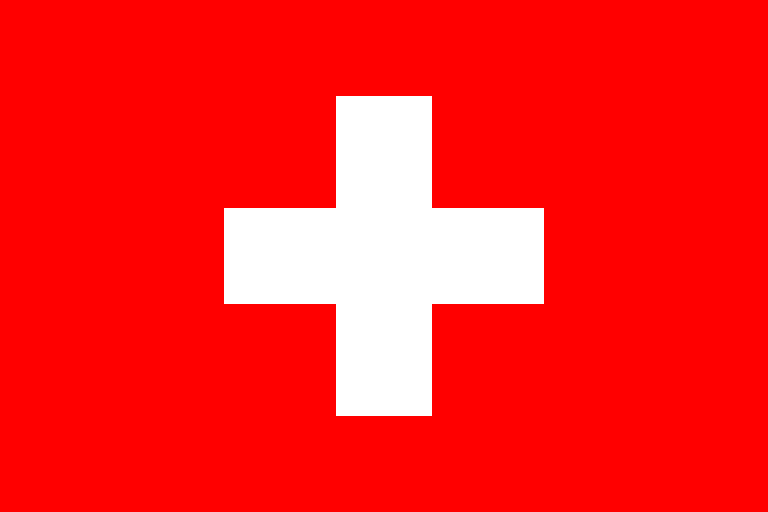
Country profile

Switzerland

Schweizerische Eidgenossenschaft (German)/ Confederation Suisse (French)/ Confederazione Svizzera (Italian)/ Confederaziun Svizra (Romansh)

Europe · Western Europe

CH · CHE

Capital
Bern
Population
9,082,848
Area
41,284 km²
Democracy index
97
Regime type
Robust Democracy

Classification

Democracy profile

The score and regime label are assigned by Porto Voto using our in-house democracy index and classification framework, not ratings from governments or external agencies.

Democracy index

97/100

Regime type

Robust Democracy

Switzerland remains a model of a robust democracy, characterized by a unique system of direct democracy that empowers citizens to propose constitutional amendments and challenge legislation through national referenda. Its political stability is underpinned by a consensus based approach, where executive power is shared among a multi party Federal Council, ensuring broad representation and institutional checks that prevent excessive concentration of authority. The rule of law is deeply embedded, with an independent judiciary and a highly transparent administrative system that maintains public trust. Fundamental civil liberties, including freedom of expression and an active, pluralistic media environment, are firmly protected. While the country engages in ongoing debates regarding international neutrality, immigration, and bilateral relationships, these discussions occur within a stable, highly decentralized framework that prioritizes civic participation and local autonomy, ensuring that the democratic system remains resilient and consistently accountable to its citizens.

Last evaluation:

How we classify regimes →

World Factbook

Country background

A concise introduction to Switzerland, together with notes on how power and law are organized, to put local ballots in context.

The Swiss Confederation was founded in 1291 as a defensive alliance among three cantons. In succeeding years, other localities joined the original three. The Swiss Confederation secured its independence from the Holy Roman Empire in 1499.

A constitution of 1848, which was modified in 1874 to allow voters to introduce referenda on proposed laws, replaced the confederation with a centralized federal government. The major European powers have long honored Switzerland's sovereignty and neutrality, and the country was not involved in either World War. The political and economic integration of Europe over the past half-century, as well as Switzerland's role in many UN and international organizations, has strengthened Switzerland's ties with its neighbors.

However, the country did not officially become a UN member until 2002. Switzerland remains active in many UN and international organizations but retains a strong commitment to neutrality.