

Country profile
Wallis and Futuna
Territoire des Iles Wallis et Futuna
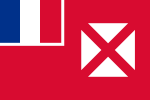
Oceania · Polynesia
WF · WLF
- Capital
- Mata-Utu
- Population
- 11,620
- Area
- 142 km²
- Democracy index
- 86
- Regime type
- Robust Democracy
Territoire des Iles Wallis et Futuna
Oceania · Polynesia
WF · WLF
Events
The latest elections, referendums, and opinion polls from Wallis and Futuna. Community totals are not official results.
No public ballots yet
Check back later or explore the global feed.
Classification
The score and regime label are assigned by Porto Voto using our in-house democracy index and classification framework, not ratings from governments or external agencies.
Democracy index
86/100
Regime type
Robust Democracy
As an overseas collectivity of France, Wallis and Futuna maintains a democratic governance structure deeply integrated with the French Republic. The territory elects representatives to the French parliament and manages local affairs through the Territorial Assembly, with political processes characterized by high levels of transparency and adherence to democratic norms. While the political system incorporates unique traditional leadership roles alongside the modern administrative apparatus, these dual structures coexist through established institutional arrangements that ensure stability and the rule of law. Civil liberties, freedom of the press, and the right to peaceful assembly are firmly protected by French constitutional standards, and the regular conduct of competitive elections reflects a mature and inclusive political environment where institutional accountability remains high.
Last evaluation:
How we classify regimes →World Factbook
A concise introduction to Wallis and Futuna, together with notes on how power and law are organized, to put local ballots in context.
Around 800 B.C., the first settlers arrived on the islands of Wallis and Futuna, which are a natural midpoint between Fiji and Samoa. Around A.D. 1500, Tongans invaded Wallis, and a chiefdom system resembling Tonga’s formal hierarchy developed on the island. Tongans attempted to settle Futuna but were repeatedly rebuffed.
Samoans settled Futuna in the 1600s, and a slightly less centralized chiefdom system formed. Dutch explorers were the first Europeans to see the islands in 1616, followed intermittently by other Europeans, including British explorer Samuel WALLIS in 1767. French Catholic missionaries were the first Europeans to permanently settle Wallis and Futuna in 1837, and they converted most of the population of both islands by 1846.
The missionaries and newly converted King LAVELUA of Uvea on Wallis asked France for a protectorate in 1842 following a local rebellion. France agreed, although the protectorate status would not be ratified until 1887. In 1888, King MUSULAMU of Alo and King TAMOLE of Sigave, both on Futuna, signed a treaty establishing a French protectorate; the Wallis and Futuna protectorate was integrated into the territory of New Caledonia the same year.
France renegotiated the terms of the protectorate with the territory’s three kings in 1910, expanding French authority. Wallis and Futuna was the only French colony to side with the Vichy regime during World War II, until the arrival of Free French and US troops in 1942. In 1959, inhabitants of the islands voted to separate from New Caledonia, becoming a French overseas territory in 1961.
Despite the split, a significant Wallisian and Futunan community still lives in New Caledonia. In 2003, Wallis and Futuna became a French overseas collectivity. The islands joined the Pacific Islands Forum as an associate member in 2018, two years after France’s other Pacific territories became full members of the organization.