

Country profile
Vanuatu
Ripablik blong Vanuatu
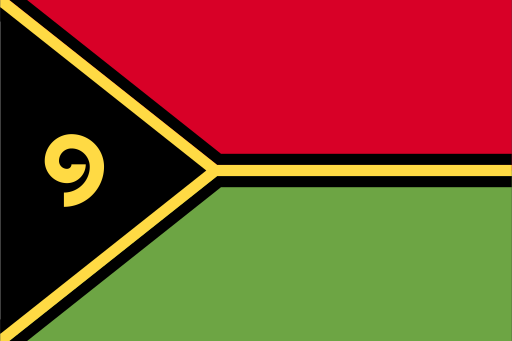
Oceania · Melanesia
VU · VUT
- Capital
- Port Vila
- Population
- 321,409
- Area
- 12,189 km²
- Democracy index
- 74
- Regime type
- Fragmented Democracy
Ripablik blong Vanuatu
Oceania · Melanesia
VU · VUT
Events
The latest elections, referendums, and opinion polls from Vanuatu. Community totals are not official results.
No public ballots yet
Check back later or explore the global feed.
Classification
The score and regime label are assigned by Porto Voto using our in-house democracy index and classification framework, not ratings from governments or external agencies.
Democracy index
74/100
Regime type
Fragmented Democracy
Vanuatu functions as a parliamentary democracy that maintains a commitment to regular, competitive elections and the peaceful transfer of power, although its political system is frequently characterized by high levels of volatility and instability. Governance is often disrupted by frequent motions of no confidence, leading to rapid shifts in government coalitions and administrative turnover that complicates long term policy development. While the constitutional framework protects fundamental civil liberties and provides for an independent judiciary, the political culture remains deeply influenced by shifting personal loyalties and localized patronage, which can undermine institutional efficacy and lead to governance bottlenecks. Despite these structural challenges and periodic episodes of political infighting, the democratic process remains resilient, with citizens actively participating in a system that values traditional consensus alongside formal legislative processes.
Last evaluation:
How we classify regimes →World Factbook
A concise introduction to Vanuatu, together with notes on how power and law are organized, to put local ballots in context.
Austronesian speakers from the Solomon Islands first settled Vanuatu around 2000 B.C. By around 1000, localized chieftain systems began to develop on the islands. Around 1600, Melanesian Chief ROI MATA united some of the islands of modern-day Vanuatu under his rule.
In 1606, a Portuguese explorer was the first European to see Vanuatu's Banks Islands and Espiritu Santo, setting up a short-lived settlement on the latter. The next European explorers arrived in the 1760s, and the islands -- then known as the New Hebrides -- were frequented by whalers in the 1800s. European interest in harvesting the islands’ sandalwood trees caused conflict with the inhabitants.
In the 1860s, European planters in Australia, Fiji, New Caledonia, and Samoa needed labor and kidnapped almost half the adult males on the islands to work as indentured servants. With growing and overlapping interests in the islands, France and the UK agreed that the New Hebrides would be neutral in 1878 and established a joint naval commission in 1887. In 1906, the two countries created the UK-France condominium to jointly administer the islands, with separate laws, police forces, currencies, and education and health systems.
The condominium arrangement was dysfunctional, and the UK used France’s initial defeat in World War II to assert greater control over the islands. During the war, the US stationed up to 50,000 soldiers in Vanuatu. In 1945, they withdrew and sold their equipment, leading to the rise of political and religious movements known as "cargo cults," such as the John Frum movement.
The UK-France condominium was reestablished after World War II. The UK was interested in moving the condominium toward independence in the 1960s, but France was hesitant. Political parties agitating for independence began to form, largely divided along linguistic lines.
France eventually relented, and elections were held in 1974, with independence granted to the newly named Vanuatu in 1980 under English-speaking Prime Minister Walter LINI. The Nagriamel Movement, with support from French-speaking landowners, then declared the island of Espiritu Santo independent from Vanuatu, but the short-lived state was dissolved 12 weeks later. Linguistic divisions have lessened over time, but highly fractious political parties have led to weak coalition governments that require support from both Anglophone and Francophone parties.
Since 2008, prime ministers have been ousted more than a dozen times through no-confidence motions or temporary procedural issues.