

Country profile
Uzbekistan
O'zbekiston Respublikasi
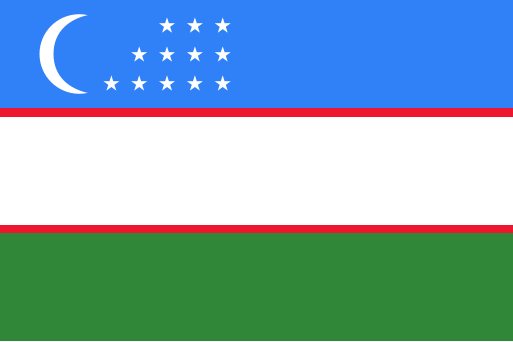
Asia · Central Asia
UZ · UZB
- Capital
- Tashkent
- Population
- 37,859,698
- Area
- 447,400 km²
- Democracy index
- 32
- Regime type
- Electoral Autocracy
O'zbekiston Respublikasi
Asia · Central Asia
UZ · UZB
Events
The latest elections, referendums, and opinion polls from Uzbekistan. Community totals are not official results.
No public ballots yet
Check back later or explore the global feed.
Classification
The score and regime label are assigned by Porto Voto using our in-house democracy index and classification framework, not ratings from governments or external agencies.
Democracy index
32/100
Regime type
Electoral Autocracy
Uzbekistan continues to function as a highly centralized electoral autocracy, where the executive branch retains absolute dominance over the political, legislative, and judicial spheres. While the government has pursued various economic reforms and modernized administrative processes, these changes have not translated into significant political liberalization. The state maintains tight control over the media and suppresses dissenting voices, with ongoing crackdowns on activists, particularly those focusing on sensitive regional issues or human rights. Elections are conducted within a restrictive environment that ensures the preservation of the existing power structure, leaving no genuine space for competitive, independent political opposition. Although the country is more open to international economic engagement than in previous decades, civil liberties remain severely curtailed, and the judicial system continues to act as an arm of the administration rather than an independent check on executive power.
Last evaluation:
How we classify regimes →World Factbook
A concise introduction to Uzbekistan, together with notes on how power and law are organized, to put local ballots in context.
Uzbekistan is the geographic and population center of Central Asia, with a diverse economy and a relatively young population. Russia conquered and united the disparate territories of present-day Uzbekistan in the late 19th century. Stiff resistance to the Red Army after the Bolshevik Revolution was eventually suppressed and a socialist republic established in 1924.
During the Soviet era, intensive production of "white gold" (cotton) and grain led to the overuse of agrochemicals and the depletion of water supplies, leaving the land degraded and the Aral Sea and certain rivers half-dry. Independent since the Union of Soviet Socialist Republics (USSR) dissolved in 1991, the country has diversified agricultural production while developing its mineral and petroleum export capacity and increasing its manufacturing base, although cotton remains a major part of its economy. Uzbekistan’s first president, Islom KARIMOV, led Uzbekistan for 25 years until his death in 2016.
His successor, former Prime Minister Shavkat MIRZIYOYEV, has improved relations with Uzbekistan’s neighbors and introduced wide-ranging economic, judicial, and social reforms. MIRZIYOYEV was reelected in 2021 with 80% of the vote and again following a 2023 constitutional referendum with 87% of the vote.