

Country profile
Turkmenistan
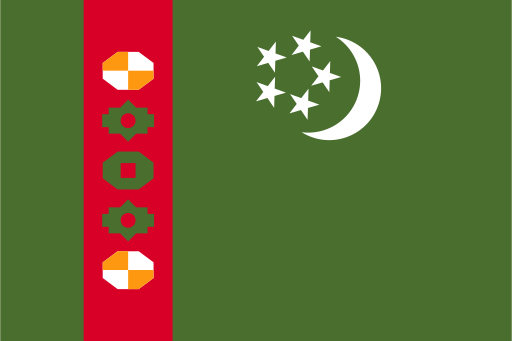
Asia · Central Asia
TM · TKM
- Capital
- Ashgabat
- Population
- 7,057,841
- Area
- 488,100 km²
- Democracy index
- 7
- Regime type
- Closed Autocracy
Asia · Central Asia
TM · TKM
Events
The latest elections, referendums, and opinion polls from Turkmenistan. Community totals are not official results.
No public ballots yet
Check back later or explore the global feed.
Classification
The score and regime label are assigned by Porto Voto using our in-house democracy index and classification framework, not ratings from governments or external agencies.
Democracy index
7/100
Regime type
Closed Autocracy
Turkmenistan remains one of the most restrictive closed autocracies in the world, characterized by the absolute consolidation of power under the presidency and a total lack of political pluralism. The state maintains complete control over all aspects of public life, including a monolithic media landscape, the absence of independent civil society, and the systematic suppression of any form of organized opposition. Legislative and judicial institutions function purely as mechanisms to ratify executive decisions, and the country is governed through a pervasive security apparatus that utilizes surveillance, arbitrary detention, and restricted movement to ensure total regime stability. Fundamental human rights, including freedom of expression and religious practice, are effectively nonexistent, and the political environment is entirely closed to any competition or accountability, leaving the populace subject to an enduring and highly centralized personalist rule.
Last evaluation:
How we classify regimes →World Factbook
A concise introduction to Turkmenistan, together with notes on how power and law are organized, to put local ballots in context.
Present-day Turkmenistan has been at the crossroads of civilizations for centuries. Various Persian empires ruled the area in antiquity, and Alexander the Great, Muslim armies, the Mongols, Turkic warriors, and eventually the Russians conquered it. In medieval times, Merv (located in present-day Mary province) was one of the great cities of the Islamic world and an important stop on the Silk Road.
Annexed by Russia in the late 1800s, Turkmen territories later figured prominently in the anti-Bolshevik resistance in Central Asia. In 1924, Turkmenistan became a Soviet republic; it achieved independence when the USSR dissolved in 1991. President for Life Saparmurat NIYAZOV died in 2006, and Gurbanguly BERDIMUHAMEDOV, a deputy chairman under NIYAZOW, emerged as the country's new president.
BERDIMUHAMEDOV won Turkmenistan's first multi-candidate presidential election in 2007, and again in 2012 and 2017 with over 97% of the vote in elections widely regarded as undemocratic. In 2022, BERDIMUHAMEDOV announced that he would step down from the presidency and called for an election to replace him. His son, Serdar BERDIMUHAMEDOV, won the ensuing election with 73% of the vote.
Gurbanguly BERDIMUHAMEDOV, although no longer head of state, maintains an influential political position as head of the Halk Maslahaty (People’s Council) and as National Leader of the Turkmen People, a title that provides additional privileges and immunity for him and his family. Since Gurbanguly BERDIMUHAMEDOV stepped down from the presidency, state-controlled media upgraded his honorific from Arkadag (protector) to Hero-Arkadag, and began referring to Serdar BERDIMUHAMEDOV as Arkadagly Serdar, which can be translated as "Serdar who has a protector to support him." Turkmenistan has sought new export markets for its extensive hydrocarbon/natural gas reserves, which have yet to be fully exploited. Turkmenistan's reliance on gas exports has made the economy vulnerable to fluctuations in the global energy market, and economic hardships since the drop in energy prices in 2014 have led many citizens of Turkmenistan to emigrate, mostly to Turkey.