

Country profile
Tunisia
Al Jumhuriyah at Tunisiyah
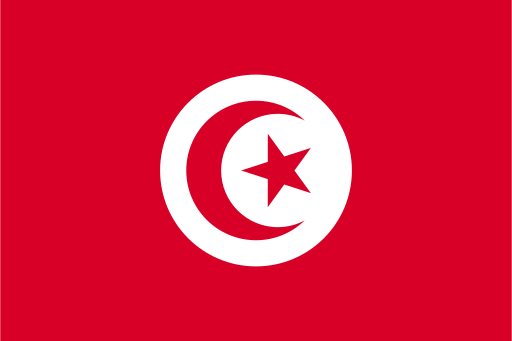
Africa · Northern Africa
TN · TUN
- Capital
- Tunis
- Population
- 11,972,169
- Area
- 163,610 km²
- Democracy index
- 28
- Regime type
- Electoral Autocracy
Al Jumhuriyah at Tunisiyah
Africa · Northern Africa
TN · TUN
Events
The latest elections, referendums, and opinion polls from Tunisia. Community totals are not official results.
No public ballots yet
Check back later or explore the global feed.
Classification
The score and regime label are assigned by Porto Voto using our in-house democracy index and classification framework, not ratings from governments or external agencies.
Democracy index
28/100
Regime type
Electoral Autocracy
Tunisia has undergone a profound democratic regression, transitioning from its post 2011 status as a nascent democracy to an electoral autocracy. Political authority is now heavily concentrated in the presidency, with Kais Saied exercising dominant control over state institutions, the judiciary, and the electoral process. Recent electoral cycles have been characterized by the systemic exclusion or imprisonment of opposition candidates, extremely low voter turnout, and the absence of a level playing field for competition. The government has increasingly utilized legal and administrative mechanisms to suppress civil society, harass independent media, and suspend human rights organizations. With the effective dismantling of checks and balances and the neutering of parliamentary oversight, the state maintains a facade of electoral legitimacy while systematically marginalizing dissent and curbing fundamental civil liberties, leaving the nation with few remnants of the pluralistic governance that once defined its transition.
Last evaluation:
How we classify regimes →World Factbook
A concise introduction to Tunisia, together with notes on how power and law are organized, to put local ballots in context.
Many empires have controlled Tunisia, including the Phoenicians (as early as the 12 century B.C.), Carthaginians, Romans, Vandals, Byzantines, various Arab and Berber kingdoms, and Ottomans (16th to late-19th centuries). Rivalry between French and Italian interests in Tunisia culminated in a French invasion in 1881 and the creation of a protectorate. Agitation for independence in the decades after World War I finally convinced the French to recognize Tunisia as an independent state in 1956.
The country's first president, Habib BOURGUIBA, established a strict one-party state. He dominated the country for 31 years, repressing Islamic fundamentalism and establishing rights for women. In 1987, Zine el Abidine BEN ALI replaced BOURGUIBA in a bloodless coup.
Street protests that began in Tunis in 2010 over high unemployment, corruption, widespread poverty, and high food prices escalated in 2011, culminating in rioting that led to hundreds of deaths and later became known as the start of the regional Arab Spring uprising. BEN ALI dismissed the government and fled the country, and a "national unity government" was formed. Elections for the new Constituent Assembly were held later that year, and human rights activist Moncef MARZOUKI was elected as interim president.
The Assembly began drafting a new constitution in 2012 and, after several iterations and a months-long political crisis that stalled the transition, ratified the document in 2014. Parliamentary and presidential elections for a permanent government were held at the end of 2014. Beji CAID ESSEBSI was elected as the first president under the country's new constitution.
After ESSEBSI’s death in office in 2019, Kais SAIED was elected. SAIED's term, as well as that of Tunisia's 217-member parliament, was set to expire in 2024. However, in 2021, SAIED used the exceptional powers allowed under Tunisia's constitution to dismiss the prime minister and suspend the legislature.
Tunisians approved a new constitution through public referendum in 2022, expanding presidential powers and creating a new bicameral legislature.