

Country profile
Trinidad and Tobago
Republic of Trinidad and Tobago
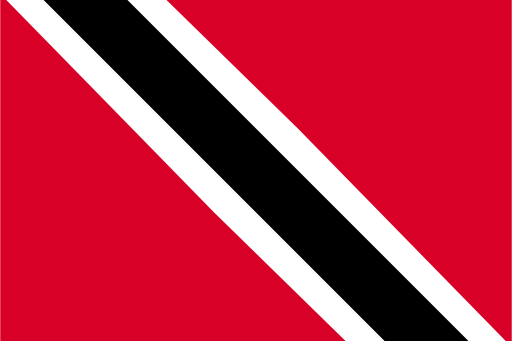
North America · Latin America and the Caribbean · Americas
TT · TTO
- Capital
- Port of Spain
- Population
- 1,367,764
- Area
- 5,130 km²
- Democracy index
- 71
- Regime type
- Fragmented Democracy
Republic of Trinidad and Tobago
North America · Latin America and the Caribbean · Americas
TT · TTO
Events
The latest elections, referendums, and opinion polls from Trinidad and Tobago. Community totals are not official results.
No public ballots yet
Check back later or explore the global feed.
Classification
The score and regime label are assigned by Porto Voto using our in-house democracy index and classification framework, not ratings from governments or external agencies.
Democracy index
71/100
Regime type
Fragmented Democracy
Trinidad and Tobago remains a parliamentary democracy with a strong tradition of regular and competitive elections, though the political landscape is heavily influenced by ethnic polarization and intense rivalry between its two main political parties. While the judiciary maintains independence and the constitutional framework protects fundamental rights, the effectiveness of governance is frequently hampered by systemic corruption, bureaucratic inertia, and a reliance on patronage networks that weaken state institutional capacity. The media environment is vibrant and pluralistic, but journalists occasionally face subtle pressure from political actors, and civil society, while active, often struggles to influence policy decisions made in a highly centralized executive system. Democratic institutions are stable and functional, yet the nation faces ongoing challenges in addressing violent crime and economic diversification, issues that contribute to a sense of political fatigue and persistent governance deadlock that occasionally tests the resilience of its democratic processes.
Last evaluation:
How we classify regimes →World Factbook
A concise introduction to Trinidad and Tobago, together with notes on how power and law are organized, to put local ballots in context.
First colonized by the Spanish, Trinidad and Tobago came under British control in the early 19th century. The emancipation of enslaved people in 1834 disrupted the twin islands' sugar industry. Contract workers arriving from India between 1845 and 1917 augmented the labor force, which boosted sugar production as well as the cocoa industry.
The discovery of oil on Trinidad in 1910 added another important export that remains the country's dominant industry. Trinidad and Tobago attained independence in 1962. The country is one of the most prosperous in the Caribbean, thanks largely to petroleum and natural gas production and processing.
The government is struggling to reverse a surge in violent crime.