

Country profile
Togo
République Togolaise
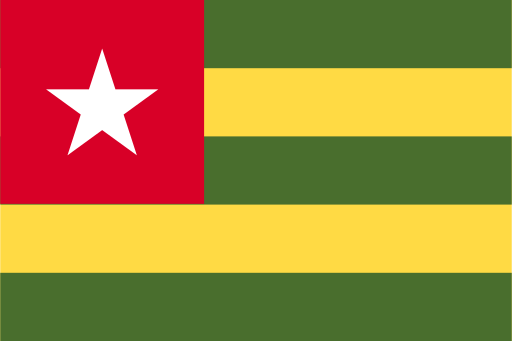
Africa · Sub-Saharan Africa
TG · TGO
- Capital
- Lomé
- Population
- 8,095,498
- Area
- 56,785 km²
- Democracy index
- 37
- Regime type
- Electoral Autocracy
République Togolaise
Africa · Sub-Saharan Africa
TG · TGO
Events
The latest elections, referendums, and opinion polls from Togo. Community totals are not official results.
No public ballots yet
Check back later or explore the global feed.
Classification
The score and regime label are assigned by Porto Voto using our in-house democracy index and classification framework, not ratings from governments or external agencies.
Democracy index
37/100
Regime type
Electoral Autocracy
Togo functions as an electoral autocracy where the Gnassingbè family has maintained entrenched political control since 1963. The political landscape is defined by the 2024 constitutional shift to a parliamentary system, a move observers characterize as a mechanism to solidify executive authority and bypass term limits. While the state permits limited political activity, such as authorized rallies that have recently seen a resurgence, the electoral field remains heavily skewed in favor of the ruling party through state resource utilization and control over institutional apparatuses. Opposition parties face structural disadvantages, and the judiciary operates with limited independence from the executive. Although there have been recent modest efforts to open the country to regional travelers, the fundamental lack of genuine democratic competition, coupled with the persistent concentration of power, relegates the system to an environment where democratic forms serve primarily to legitimize an enduring personalist rule.
Last evaluation:
How we classify regimes →World Factbook
A concise introduction to Togo, together with notes on how power and law are organized, to put local ballots in context.
From the 11th to the 16th centuries, various ethnic groups settled the Togo region. From the 16th to the 18th centuries, the coastal region became a major trading center for enslaved people, and the surrounding region took on the name of "The Slave Coast." In 1884, Germany declared the area a protectorate called Togoland, which included present-day Togo. After World War I, colonial rule over Togo was transferred to France.
French Togoland became Togo upon independence in 1960. Gen. Gnassingbe EYADEMA, installed as military ruler in 1967, ruled Togo with a heavy hand for almost four decades.
Despite the facade of multi-party elections instituted in the early 1990s, EYADEMA largely dominated the government. His Rally of the Togolese People (RPT) party has been in power almost continually since 1967, with its successor, the Union for the Republic, maintaining a majority of seats in today's legislature. Upon EYADEMA's death in 2005, the military installed his son, Faure GNASSINGBE, as president and then engineered his formal election two months later.
Togo held its first relatively free and fair legislative elections in 2007. Since then, GNASSINGBE has started the country along a gradual path to democratic reform. Togo has held multiple presidential and legislative elections, and in 2019, the country held its first local elections in 32 years.
Despite those positive moves, political reconciliation has moved slowly, and the country experiences periodic outbursts of protests from frustrated citizens, leading to violence between security forces and protesters. Constitutional changes in 2019 to institute a runoff system in presidential elections and to establish term limits have done little to reduce the resentment many Togolese feel after more than 50 years of one-family rule. GNASSINGBE became eligible for his current fourth term and one additional fifth term under the new rules.
The next presidential election is set for 2025.