

Country profile
Tanzania
Jamhuri ya Muungano wa Tanzania
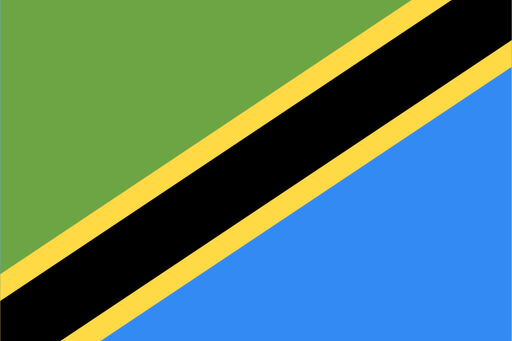
Africa · Sub-Saharan Africa
TZ · TZA
- Capital
- Dodoma
- Population
- 68,153,004
- Area
- 947,303 km²
- Democracy index
- 52
- Regime type
- Hybrid Regime
Jamhuri ya Muungano wa Tanzania
Africa · Sub-Saharan Africa
TZ · TZA
Events
The latest elections, referendums, and opinion polls from Tanzania. Community totals are not official results.
No public ballots yet
Check back later or explore the global feed.
Classification
The score and regime label are assigned by Porto Voto using our in-house democracy index and classification framework, not ratings from governments or external agencies.
Democracy index
52/100
Regime type
Hybrid Regime
Tanzania remains a hybrid regime characterized by the gradual expansion of political space following the restrictive policies of the previous administration, yet the environment remains constrained by significant structural imbalances. While the government has allowed for greater opposition activity and permitted the return of some exiled political figures, the executive branch maintains firm control over key state institutions, including the judiciary and the electoral commission, which prevents a level playing field for political competition. Civil society organizations and independent media operate with more freedom than in the past, though they continue to face self censorship and occasional harassment when addressing sensitive or high level issues. The ruling party retains a dominant grip on administrative and political resources, creating a system where competition is possible but fundamentally skewed in favor of the incumbent. Long term democratic progress remains contingent upon deeper legal reforms to separate party and state functions and ensure that democratic gains are institutionalized rather than remaining subject to executive discretion.
Last evaluation:
How we classify regimes →World Factbook
A concise introduction to Tanzania, together with notes on how power and law are organized, to put local ballots in context.
Tanzania contains some of Africa’s most iconic national parks and famous paleoanthropological sites, and its diverse cultural heritage reflects the multiple ethnolinguistic groups that live in the country. Its long history of integration into trade networks spanning the Indian Ocean and the African interior led to the development of Swahili as a common language in much of east Africa and the introduction of Islam into the region. A number of independent coastal and island trading posts in what is now Tanzania came under Portuguese control after 1498 when they began to take control of much of the coast and Indian Ocean trade.
By 1700, the Sultanate of Oman had become the dominant power in the region after ousting the Portuguese, who were also facing a series of local uprisings. During the next hundred years, Zanzibar -- an archipelago off the coast that is now part of Tanzania -- became a hub of Indian Ocean trade, with Arab and Indian traders establishing and consolidating trade routes with communities in mainland Tanzania that contributed to the expansion of the slave trade. Zanzibar briefly became the capital of the Sultanate of Oman before it split into separate Omani and Zanzibar Sultanates in 1856.
Beginning in the mid-1800s, European explorers, traders, and Christian missionaries became more active in the region. The Germans eventually established control over mainland Tanzania -- which they called Tanganyika -- and the British established control over Zanzibar. Tanganyika came under British administration after the German defeat in World War I.
Tanganyika gained independence from Great Britain in 1961, and Zanzibar followed in 1963 as a constitutional monarchy. In Tanganyika, Julius NYERERE, a charismatic and idealistic socialist, established a one-party political system that centralized power and encouraged national self-reliance and rural development. In 1964, a popular uprising overthrew the Sultan in Zanzibar and either killed or expelled many of the Arabs and Indians who had dominated the isles for more than 200 years.
Later that year, Tanganyika and Zanzibar combined to form the United Republic of Tanzania, but Zanzibar retained considerable autonomy. Their two ruling parties combined to form the Chama Cha Mapinduzi (CCM) party in 1977, which has since won every presidential election. Tanzania held its first multi-party elections in 1995, but CCM candidates have continued to dominate politics.
The ruling party has claimed victory in four contentious elections since 1995, despite international observers' claims of voting irregularities. In 2001, 35 people died in Zanzibar when soldiers fired on protestors. John MAGUFULI won the 2015 and 2020 presidential elections, and the CCM won over two-thirds of the seats in Parliament in both elections.
MAGUFULI died in 2021 while in office and was succeeded by his vice president, Samia Suluhu HASSAN.