

Country profile
Syrian Arab Republic
Al Jumhuriyah al Arabiyah as Suriyah
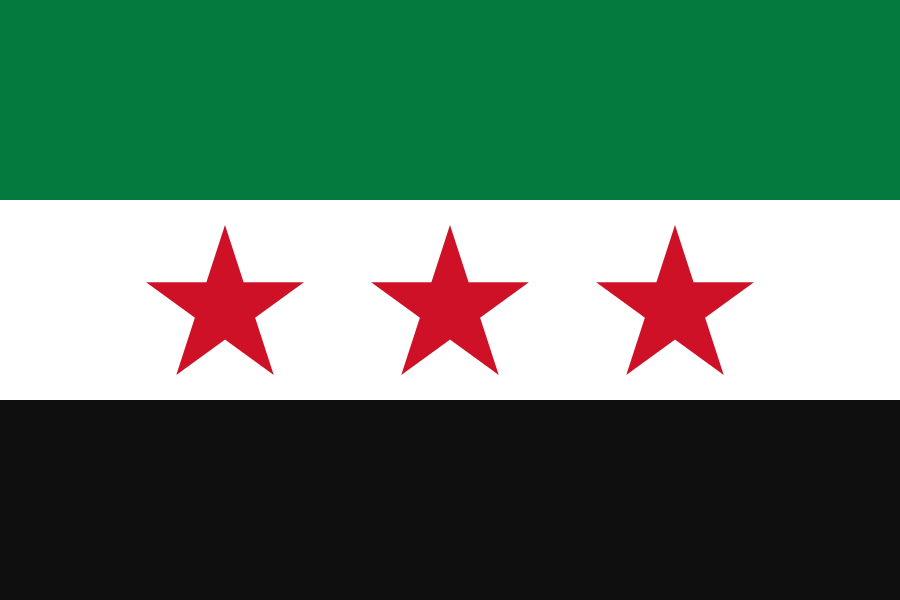
Asia · Western Asia
SY · SYR
- Capital
- Damascus
- Population
- 25,620,000
- Area
- 185,180 km²
- Democracy index
- 6
- Regime type
- Closed Autocracy
Al Jumhuriyah al Arabiyah as Suriyah
Asia · Western Asia
SY · SYR
Events
The latest elections, referendums, and opinion polls from Syrian Arab Republic. Community totals are not official results.
No public ballots yet
Check back later or explore the global feed.
Classification
The score and regime label are assigned by Porto Voto using our in-house democracy index and classification framework, not ratings from governments or external agencies.
Democracy index
6/100
Regime type
Closed Autocracy
The Syrian Arab Republic remains a closed autocracy where political authority is entirely concentrated in the hands of the executive and the security apparatus. Following over a decade of civil war, the state maintains a facade of governance while systematically suppressing all forms of organized political dissent, independent media, and civil society. The regime ensures its survival through pervasive surveillance, arbitrary detention, and the use of violence against perceived opponents, effectively eliminating any space for meaningful democratic competition. Institutional integrity is non existent, as the judiciary and administrative branches operate solely to serve regime interests, and international efforts to achieve a political transition have consistently stalled. The population remains subjected to extreme restrictions on fundamental human rights, and the government exerts control through a combination of military force and strategic patronage, leaving no room for pluralism or accountability.
Last evaluation:
How we classify regimes →World Factbook
A concise introduction to Syrian Arab Republic, together with notes on how power and law are organized, to put local ballots in context.
After World War I, France acquired a mandate over the northern portion of the former Ottoman Empire province of Syria. The French administered the area until granting it independence in 1946. The new country lacked political stability and experienced a series of military coups.
Syria united with Egypt in 1958 to form the United Arab Republic. In 1961, the two entities separated, and the Syrian Arab Republic was reestablished. In the 1967 Arab-Israeli War, Syria lost control of the Golan Heights region to Israel.
During the 1990s, Syria and Israel held occasional, albeit unsuccessful, peace talks over its return. In 1970, Hafiz al-ASAD, a member of the socialist Ba'ath Party and the minority Alawi sect, seized power in a bloodless coup and brought political stability to the country. Following the death of al-ASAD, his son, Bashar al-ASAD, was approved as president by popular referendum in 2000.
Syrian troops that were stationed in Lebanon since 1976 in an ostensible peacekeeping role were withdrawn in 2005. During the 2006 conflict between Israel and Hizballah, Syria placed its military forces on alert but did not intervene directly on behalf of its ally Hizballah. In 2007, Bashar al-ASAD's second term as president was again approved in a referendum.
In the wake of major uprisings elsewhere in the region, antigovernment protests broke out in the southern province of Dar'a in 2011. Protesters called for the legalization of political parties, the removal of corrupt local officials, and the repeal of the restrictive Emergency Law allowing arrests without charge. Demonstrations and violent unrest spread across Syria, and the government responded with concessions, but also with military force and detentions that led to extended clashes and eventually civil war.
International pressure on the Syrian Government intensified after 2011, as the Arab League, the EU, Turkey, and the US expanded economic sanctions against the ASAD regime and those entities that supported it. In 2012, more than 130 countries recognized the Syrian National Coalition as the sole legitimate representative of the Syrian people. In 2015, Russia launched a military intervention on behalf of the ASAD regime, and domestic and foreign-government-aligned forces recaptured swaths of territory from opposition forces.
With foreign support, the regime continued to periodically regain opposition-held territory until 2020, when Turkish firepower halted a regime advance and forced a stalemate between regime and opposition forces. The government lacks territorial control over much of the northeastern part of the country, which the predominantly Kurdish Syrian Democratic Forces (SDF) hold, and a smaller area dominated by Turkey. Since 2016, Turkey has conducted three large-scale military operations to capture territory along Syria's northern border.
Some opposition forces organized under the Turkish-backed Syrian National Army and Turkish forces have maintained control of northwestern Syria along the Turkish border with the Afrin area of Aleppo Province since 2018. The violent extremist organization Hay’at Tahrir al-Sham (formerly the Nusrah Front) emerged in 2017 as the predominant opposition force in Idlib Province, and still dominates an area also hosting Turkish forces. Negotiations have failed to produce a resolution to the conflict, and the UN estimated in 2022 that at least 306,000 people have died during the civil war.
Approximately 6.7 million Syrians were internally displaced as of 2022, and 14.6 million people were in need of humanitarian assistance across the country. An additional 5.6 million Syrians were registered refugees in Turkey, Jordan, Iraq, Egypt, and North Africa. The conflict in Syria remains one of the two largest displacement crises worldwide (the other is the full-scale invasion of Ukraine).
On 8 December 2024, Syrian Islamist rebels captured the capital city of Damascus and overthrew President Bashar al-ASAD. The former president and his family fled to Moscow, where they were granted political asylum. The al-ASAD regime had ruled Syria for over 50 years.