

Country profile
Solomon Islands
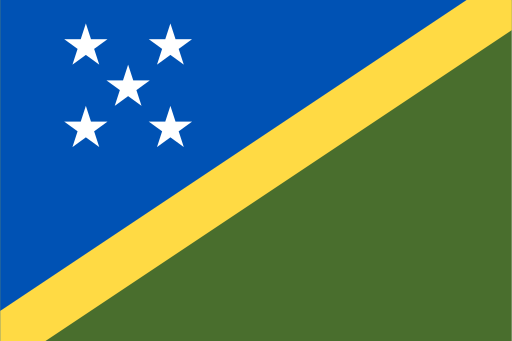
Oceania · Melanesia
SB · SLB
- Capital
- Honiara
- Population
- 750,325
- Area
- 28,896 km²
- Democracy index
- 73
- Regime type
- Fragmented Democracy
Oceania · Melanesia
SB · SLB
Events
The latest elections, referendums, and opinion polls from Solomon Islands. Community totals are not official results.
No public ballots yet
Check back later or explore the global feed.
Classification
The score and regime label are assigned by Porto Voto using our in-house democracy index and classification framework, not ratings from governments or external agencies.
Democracy index
73/100
Regime type
Fragmented Democracy
Solomon Islands functions as a parliamentary democracy that maintains regular electoral cycles and constitutional mechanisms for power transitions, though the political system is frequently hampered by intense instability and governance friction. The recent May 2026 removal of Prime Minister Jeremiah Manele following a motion of no confidence underscores the volatility inherent in its coalition based politics, where frequent shifts in loyalty often lead to administrative paralysis and disruptive political impasses. While the judiciary and independent court rulings successfully upheld the parliamentary process during the recent crisis, ensuring the eventual assembly of the legislature, the reliance on fragile, cross party alliances creates a perpetual state of political precariousness. Governance is additionally challenged by systemic corruption, revenue leakage through informal port operations, and the difficulty of implementing long term policy agendas within short legislative windows. Although fundamental civil liberties and media freedoms remain intact, the environment is characterized by recurring executive turnover and deep political polarization that periodically strain the nation's democratic institutions.
Last evaluation:
How we classify regimes →World Factbook
A concise introduction to Solomon Islands, together with notes on how power and law are organized, to put local ballots in context.
Settlers from Papua arrived on the Solomon Islands around 30,000 years ago. About 6,000 years ago, Austronesian settlers came to the islands, and the two groups mixed extensively. Despite significant inter-island trade, no attempts were made to unite the islands into a single political entity.
In 1568, a Spanish explorer became the first European to spot the islands. After a failed Spanish attempt at creating a permanent European settlement in the late 1500s, the Solomon Islands remained free of European contact until a British explorer arrived in 1767. European explorers and US and British whaling ships regularly visited the islands into the 1800s.
Germany declared a protectorate over the northern Solomon Islands in 1885, and the UK established a protectorate over the southern islands in 1893. In 1899, Germany transferred its islands to the UK in exchange for the UK relinquishing all claims in Samoa. In 1942, Japan invaded the islands, and the Guadalcanal Campaign (August 1942-February 1943) proved a turning point in the Pacific theater of WWII.
The fighting destroyed large parts of the Solomon Islands, and a nationalist movement emerged near the end of the war. By 1960, the British allowed some local autonomy. The islands were granted self-government in 1976 and independence two years later under Prime Minister Sir Peter KENILOREA.
In 1999, longstanding tensions between ethnic Guale in Honiara and ethnic Malaitans in Honiara’s suburbs erupted in civil war, leading thousands of Malaitans to take refuge in Honiara and prompting Guale to flee the city. In 2000, newly elected Prime Minister Manasseh SOGAVARE focused on peace agreements and distributing resources equally among groups, but his actions bankrupted the government in 2001 and led to his ouster. In 2003, the Solomon Islands requested international assistance to reestablish law and order; the Australian-led Regional Assistance Mission to the Solomon Islands, which ended in 2017, improved the security situation.
In 2006, however, riots broke out in Honiara, and the city’s Chinatown was burned amid allegations that the prime minister took money from China. SOGAVARE was reelected prime minister for a fourth time in 2019. When a small group of protestors, mostly from the island of Malaita, approached parliament to lodge a petition calling for SOGAVARE’s removal and more development in Malaita in 2021, police fired tear gas into the crowd which sparked rioting and looting in Honiara.