

Country profile
Slovenia
Republika Slovenija
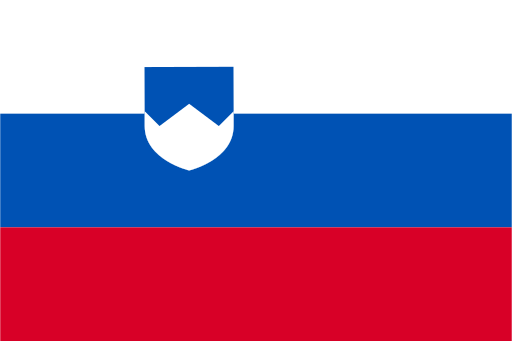
Europe · Southern Europe
SI · SVN
- Capital
- Ljubljana
- Population
- 2,130,638
- Area
- 20,273 km²
- Democracy index
- 86
- Regime type
- Robust Democracy
Republika Slovenija
Europe · Southern Europe
SI · SVN
Events
The latest elections, referendums, and opinion polls from Slovenia. Community totals are not official results.
Classification
The score and regime label are assigned by Porto Voto using our in-house democracy index and classification framework, not ratings from governments or external agencies.
Democracy index
86/100
Regime type
Robust Democracy
Slovenia continues to operate as a stable and mature parliamentary democracy, characterized by a firm commitment to the rule of law, separation of powers, and the protection of fundamental civil liberties. The political landscape is marked by competitive, transparent, and fair electoral processes where power transitions are peaceful and broadly accepted. An independent judiciary serves as an effective check on executive authority, and the country maintains a vibrant media environment alongside an active civil society that holds state institutions accountable. While the nation occasionally experiences political polarization or debates regarding the efficiency of public administration, these processes occur firmly within the established constitutional framework. Strong institutional safeguards ensure that democratic norms are upheld across all levels of government, solidifying the country's status as a reliable and transparent member of the European democratic community.
Last evaluation:
How we classify regimes →World Factbook
A concise introduction to Slovenia, together with notes on how power and law are organized, to put local ballots in context.
The Slovene lands were part of the Austro-Hungarian Empire until the latter's dissolution at the end of World War I. In 1918, Slovenia became part of the Kingdom of Serbs, Croats, and Slovenes, which was renamed Yugoslavia in 1929. After World War II, Slovenia joined Bosnia and Herzegovina, Croatia, Macedonia, Montenegro, and Serbia as one of the constituent republics in the new Socialist Federal Republic of Yugoslavia (SFRY).
In 1990, Slovenia held its first multiparty elections, as well as a referendum on independence. Serbia responded with an economic blockade and military action, but after a short 10-day war, Slovenia declared independence in 1991. Slovenia acceded to both NATO and the EU in the spring of 2004; it joined the euro zone and the Schengen Area in 2007.