

Country profile
Slovakia
Slovenska republika
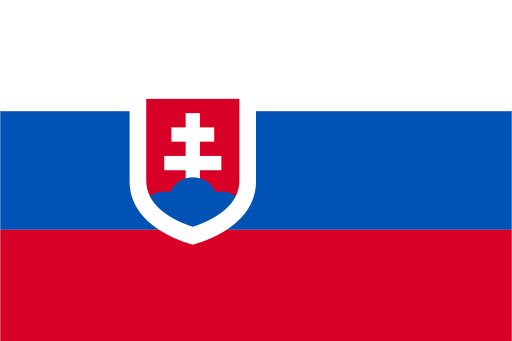
Europe · Eastern Europe
SK · SVK
- Capital
- Bratislava
- Population
- 5,413,813
- Area
- 49,037 km²
- Democracy index
- 71
- Regime type
- Fragmented Democracy
Slovenska republika
Europe · Eastern Europe
SK · SVK
Events
The latest elections, referendums, and opinion polls from Slovakia. Community totals are not official results.
Classification
The score and regime label are assigned by Porto Voto using our in-house democracy index and classification framework, not ratings from governments or external agencies.
Democracy index
71/100
Regime type
Fragmented Democracy
Slovakia currently maintains the essential framework of a parliamentary democracy, yet it faces significant institutional strain and political polarization that characterize a fragmented democratic environment. Recent government initiatives, including controversial reforms to the criminal code, the dismantling of specialized anti-corruption entities, and pressure on public service media, have raised alarm bells regarding the independence of the judiciary and the protection of democratic safeguards. European Parliament resolutions have specifically highlighted concerns about the government's rhetoric, constitutional shifts that challenge the primacy of EU law, and the potential misuse of public funds, which have intensified friction between national authorities and EU institutions. While electoral processes remain functional and power transfers are constitutionally governed, the ruling coalition's efforts to exert influence over state institutions, coupled with the narrowing space for civil society and critical journalism, have weakened the country's institutional resilience. These developments suggest a democracy that is struggling to balance its commitment to established liberal norms against an increasingly centralized and confrontational approach to national governance.
Last evaluation:
How we classify regimes →World Factbook
A concise introduction to Slovakia, together with notes on how power and law are organized, to put local ballots in context.
Slovakia traces its roots to the 9th century state of Great Moravia. The Slovaks then became part of the Hungarian Kingdom, where they remained for the next 1,000 years. After the formation of the dual Austro-Hungarian monarchy in 1867, language and education policies favoring the use of Hungarian (known as "Magyarization") led to a public backlash that boosted Slovak nationalism and strengthened Slovak cultural ties with the closely related Czechs, who fell administratively under the Austrian half of the empire.
When the Austro-Hungarian Empire dissolved at the end of World War I, the Slovaks joined the Czechs to form Czechoslovakia. During the interwar period, Slovak nationalist leaders pushed for autonomy within Czechoslovakia, and in 1939, in the wake of Germany's annexation of the Sudetenland, the newly established Slovak Republic became a German client state for the remainder of World War II. After World War II, Czechoslovakia was reconstituted and came under communist rule within Soviet-dominated Eastern Europe.
In 1968, Warsaw Pact troops invaded and ended the efforts of Czechoslovakia's leaders to liberalize communist rule and create "socialism with a human face," ushering in a period of repression known as "normalization." The peaceful Velvet Revolution swept the Communist Party from power at the end of 1989 and inaugurated a return to democratic rule and a market economy. On 1 January 1993, Czechoslovakia underwent a nonviolent "velvet divorce" into its two national components, Slovakia and the Czech Republic. Slovakia joined both NATO and the EU in 2004 and the euro zone in 2009.