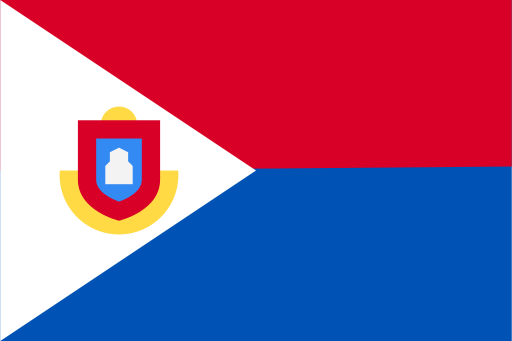
Country profile

Sint Maarten (Dutch part)

Land Sint Maarten (Dutch)/ Country of Sint Maarten (English)

North America · Latin America and the Caribbean · Americas

SX · SXM

Capital
Philipsburg
Population
41,349
Area
34 km²
Democracy index
85
Regime type
Robust Democracy

Events

Ballots from Sint Maarten (Dutch part)

The latest elections, referendums, and opinion polls from Sint Maarten (Dutch part). Community totals are not official results.

No published ballots yet

No public ballots yet

Check back later or explore the global feed.

Classification

Democracy profile

The score and regime label are assigned by Porto Voto using our in-house democracy index and classification framework, not ratings from governments or external agencies.

Democracy index

85/100

Regime type

Robust Democracy

As a constituent country within the Kingdom of the Netherlands, Sint Maarten operates under a parliamentary democratic system that upholds the rule of law and constitutional protections. The island maintains regular and competitive elections where political power is determined through a multi party system, ensuring the peaceful transition of authority. While the territory faces logistical challenges related to its status as a small island developing state, its institutional framework remains anchored by the broader standards of the Dutch constitutional order, which guarantees an independent judiciary and the protection of fundamental civil liberties. Civic engagement remains active, and a relatively free press allows for public discourse on national governance. The political environment is characterized by adherence to democratic norms and a commitment to transparency, ensuring that state institutions remain accountable to the public despite the complexities of local political coalition building.

Last evaluation:

How we classify regimes →

World Factbook

Country background

A concise introduction to Sint Maarten (Dutch part), together with notes on how power and law are organized, to put local ballots in context.

Christopher COLUMBUS claimed Saint Martin for Spain in 1493, naming it after the feast day of St. Martin of Tours, but it was the Dutch who occupied the island in 1631 to exploit its salt deposits. The Spanish retook Saint Martin in 1633, but the Dutch continued to assert their claims.

The Spanish finally relinquished the island to the French and Dutch, who divided it between themselves in 1648. The border frequently fluctuated over the next 200 years because of friction between the two countries, with the Dutch eventually holding the smaller portion of the island (about 39%) and adopting the Dutch spelling of the island's name for their territory. The establishment of cotton, tobacco, and sugar plantations dramatically expanded African slavery on the island in the 18th and 19th centuries; the practice was not abolished in the Dutch half until 1863.

The island's economy declined until 1939 when it became a free port; the tourism industry was dramatically expanded beginning in the 1950s. In 1954, Sint Maarten and several other Dutch Caribbean possessions became part of the Kingdom of the Netherlands as the Netherlands Antilles. In a 2000 referendum, the citizens of Sint Maarten voted to become a self-governing country within the Kingdom of the Netherlands, effective in 2010.

In 2017, Hurricane Irma hit Saint Martin/Sint Maarten, causing extensive damage to roads, communications, electrical power, and housing; the UN estimated that 90% of the buildings were damaged or destroyed.