

Country profile
Singapore
Republic of Singapore
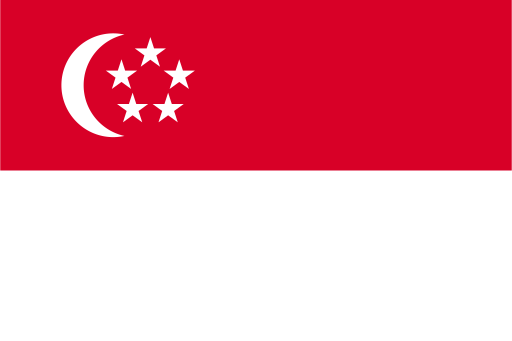
Asia · South-eastern Asia
SG · SGP
- Capital
- Singapore
- Population
- 6,110,200
- Area
- 710 km²
- Democracy index
- 62
- Regime type
- Hybrid Regime
Republic of Singapore
Asia · South-eastern Asia
SG · SGP
Events
The latest elections, referendums, and opinion polls from Singapore. Community totals are not official results.
No public ballots yet
Check back later or explore the global feed.
Classification
The score and regime label are assigned by Porto Voto using our in-house democracy index and classification framework, not ratings from governments or external agencies.
Democracy index
62/100
Regime type
Hybrid Regime
Singapore functions as a hybrid regime where democratic processes such as regular elections coexist with significant structural advantages for the long ruling People Action Party. The electoral landscape is heavily influenced by the ruling party through strict control over mainstream media, restrictive legislation on public assembly, and strategic use of defamation laws against political opponents. While the judiciary operates with high efficiency and maintains the rule of law in commercial and criminal matters, its independence in politically sensitive cases remains subject to scrutiny. Civic space is tightly managed, and while opposition parties exist and participate in parliament, they face systemic barriers to gaining political traction. Governance is characterized by high levels of administrative competence and transparency in public service, yet the political environment lacks the competitive pluralism required for a robust democracy, reflecting a system that prioritizes stability and state control over liberal democratic accountability.
Last evaluation:
How we classify regimes →World Factbook
A concise introduction to Singapore, together with notes on how power and law are organized, to put local ballots in context.
A Malay trading port known as Temasek existed on the island of Singapore by the 14th century. The settlement changed hands several times in the ensuing centuries and was eventually burned in the 17th century, falling into obscurity. In 1819, the British founded modern Singapore as a trading colony on the same site and granted it full internal self-government for all matters except defense and foreign affairs in 1959.
Singapore joined the Malaysian Federation in 1963 but was ousted two years later and became independent. Singapore subsequently became one of the world's most prosperous countries, with strong international trading links and per capita GDP among the highest globally. The People’s Action Party has won every general election in Singapore since the end of the British colonial era, aided by its success in delivering consistent economic growth, as well as the city-state's fragmented opposition and electoral procedures that strongly favor the ruling party.