

Country profile
Serbia
Republika Srbija
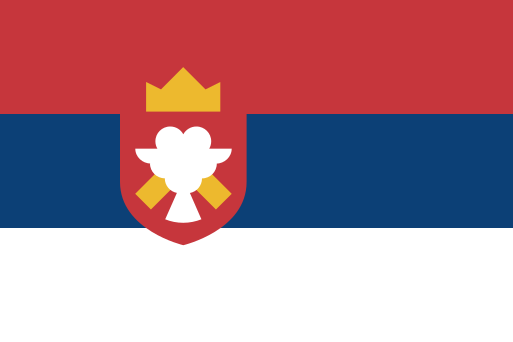
Europe · Southern Europe
RS · SRB
- Capital
- Belgrade
- Population
- 6,567,783
- Area
- 77,589 km²
- Democracy index
- 58
- Regime type
- Hybrid Regime
Republika Srbija
Europe · Southern Europe
RS · SRB
Events
The latest elections, referendums, and opinion polls from Serbia. Community totals are not official results.
Classification
The score and regime label are assigned by Porto Voto using our in-house democracy index and classification framework, not ratings from governments or external agencies.
Democracy index
58/100
Regime type
Hybrid Regime
Serbia functions as a hybrid regime characterized by the dominance of the ruling Serbian Progressive Party, which maintains a grip on state institutions, public resources, and the media landscape. While elections occur, the playing field remains significantly skewed in favor of the incumbent through extensive control over mainstream media outlets and the use of patronage networks to secure voter turnout. Political competition is hampered by pressure on civil servants, the targeting of critical voices, and an increasingly polarized atmosphere that makes meaningful institutional accountability difficult. Although the judiciary and electoral bodies technically operate under a democratic legal framework, they face persistent allegations of executive interference and lack the independence necessary to serve as an effective check on power. The political system is marked by a cycle of periodic protest and democratic backsliding, with public trust in state institutions remaining fragile due to systemic corruption and a lack of transparency in governance processes.
Last evaluation:
How we classify regimes →World Factbook
A concise introduction to Serbia, together with notes on how power and law are organized, to put local ballots in context.
In 1918, the Croats, Serbs, and Slovenes formed a kingdom known after 1929 as Yugoslavia. The monarchy remained in power until 1945, when the communist Partisans headed by Josip Broz (aka TITO) took control of the newly created Socialist Federal Republic of Yugoslavia (SFRY). After TITO died in 1980, communism in Yugoslavia gradually gave way to resurgent nationalism.
In 1989, Slobodan MILOSEVIC became president of the Republic of Serbia, and his calls for Serbian domination led to the violent breakup of Yugoslavia along ethnic lines. In 1991, Croatia, Slovenia, and Macedonia declared independence, followed by Bosnia in 1992. The remaining republics of Serbia and Montenegro declared a new Federal Republic of Yugoslavia (FRY) in 1992, and MILOSEVIC led military campaigns to unite ethnic Serbs in neighboring republics into a "Greater Serbia." These actions ultimately failed, and international intervention led to the signing of the Dayton Accords in 1995.
In 1998, an ethnic Albanian insurgency in the formerly autonomous Serbian province of Kosovo resulted in a brutal Serbian counterinsurgency campaign. Serbia rejected a proposed international settlement, and NATO responded with a bombing campaign that forced Serbian forces to withdraw from Kosovo in June 1999. In 2003, the FRY became the State Union of Serbia and Montenegro, a loose federation of the two republics.
In 2006, Montenegro seceded and declared itself an independent nation. In 2008, Kosovo also declared independence -- an action Serbia still refuses to recognize. In 2013, Serbia and Kosovo signed the first agreement of principles governing the normalization of relations between the two countries.
Additional agreements were reached in 2015 and 2023, but implementation remains incomplete. Serbia has been an official candidate for EU membership since 2012, and President Aleksandar VUCIC has promoted the ambitious goal of Serbia joining the EU by 2025.