

Country profile
Saint Helena, Ascension and Tristan da Cunha
Saint Helena, Ascension, and Tristan da Cunha
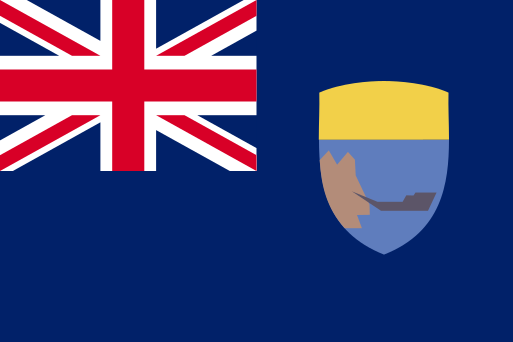
Africa · Sub-Saharan Africa
SH · SHN
- Capital
- Jamestown
- Population
- 5,651
- Area
- 394 km²
- Democracy index
- 87
- Regime type
- Robust Democracy
Saint Helena, Ascension, and Tristan da Cunha
Africa · Sub-Saharan Africa
SH · SHN
Events
The latest elections, referendums, and opinion polls from Saint Helena, Ascension and Tristan da Cunha. Community totals are not official results.
No public ballots yet
Check back later or explore the global feed.
Classification
The score and regime label are assigned by Porto Voto using our in-house democracy index and classification framework, not ratings from governments or external agencies.
Democracy index
87/100
Regime type
Robust Democracy
As a British Overseas Territory, these islands operate under a stable framework of governance that aligns with the constitutional principles of the United Kingdom. Local administration is conducted through the Legislative Council, which provides a forum for democratic representation, while the judicial system is rooted in English law, ensuring the protection of fundamental rights and the rule of law. Political life is marked by high levels of civic participation and a focus on localized community issues, rather than the intense partisan polarization seen in larger sovereign states. Administrative transparency and a commitment to public accountability remain strong, resulting in a mature and secure democratic environment that benefits from the institutional support and oversight mechanisms of the British government.
Last evaluation:
How we classify regimes →World Factbook
A concise introduction to Saint Helena, Ascension and Tristan da Cunha, together with notes on how power and law are organized, to put local ballots in context.
Saint Helena is a British Overseas Territory off the coast of Africa in the South Atlantic Ocean, and it consists of Saint Helena, Ascension Island, and the island group of Tristan da Cunha. Saint Helena: The island was uninhabited when the Portuguese first discovered it in 1502, and the British garrisoned troops on Saint Helena during the 17th century. It acquired fame as the place of Napoleon BONAPARTE's exile from 1815 until his death in 1821, but its importance as a port of call declined after the opening of the Suez Canal in 1869.
During the Anglo-Boer War in South Africa, several thousand Boer prisoners were confined on the island between 1900 and 1903. Saint Helena is one of the most remote populated places in the world. The British Government committed to building an airport on Saint Helena in 2005.
After more than a decade of delays and construction, a commercial air service to South Africa via Namibia was inaugurated in 2017. The weekly service to Saint Helena from Johannesburg via Windhoek in Namibia takes just over six hours (including the refueling stop in Windhoek) and replaces the mail ship that had made a five-day journey to the island every three weeks. Ascension Island: This barren and uninhabited island was discovered and named by the Portuguese in 1503.
The British garrisoned the island in 1815 to prevent a rescue of NAPOLEON from Saint Helena. It served as a provisioning station for the Royal Navy's West Africa Squadron on anti-slavery patrol. The island remained under Admiralty control until 1922, when it became a dependency of Saint Helena.
During World War II, the UK permitted the US to construct an airfield on Ascension in support of transatlantic flights to Africa and anti-submarine operations in the South Atlantic. In the 1960s, the island became an important space tracking station for the US. In 1982, Ascension was an essential staging area for British forces during the Falklands War.
It remains a critical refueling point in the air-bridge from the UK to the South Atlantic. The island hosts one of four dedicated ground antennas that assist in the operation of the Global Positioning System (GPS) navigation system -- the others are on Diego Garcia (British Indian Ocean Territory), Kwajalein (Marshall Islands), and at Cape Canaveral, Florida (US). NASA and the US Air Force also operate a Meter-Class Autonomous Telescope (MCAT) on Ascension as part of the deep space surveillance system for tracking orbital debris, which can be a hazard to spacecraft and astronauts.
Tristan da Cunha: The island group consists of Tristan da Cunha, Nightingale, Inaccessible, and Gough Islands. Tristan da Cunha, named after its Portuguese discoverer (1506), was garrisoned by the British in 1816 to prevent any attempt to rescue NAPOLEON from Saint Helena. Gough and Inaccessible Islands have been designated World Heritage Sites.
South Africa leases a site for a meteorological station on Gough Island.