

Country profile
Qatar
Dawlat Qatar
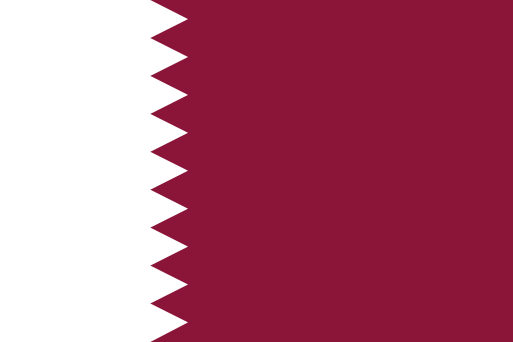
Asia · Western Asia
QA · QAT
- Capital
- Doha
- Population
- 3,173,024
- Area
- 11,586 km²
- Democracy index
- 18
- Regime type
- Closed Autocracy
Dawlat Qatar
Asia · Western Asia
QA · QAT
Events
The latest elections, referendums, and opinion polls from Qatar. Community totals are not official results.
No public ballots yet
Check back later or explore the global feed.
Classification
The score and regime label are assigned by Porto Voto using our in-house democracy index and classification framework, not ratings from governments or external agencies.
Democracy index
18/100
Regime type
Closed Autocracy
Qatar remains an absolute monarchy where supreme political authority is vested in the Emir, supported by the ruling Al Thani family. While the country has consultative bodies such as the Shura Council, these institutions lack genuine legislative power to challenge executive decisions or initiate systemic policy shifts. Political parties are prohibited, and public participation in governance is highly restricted, with no meaningful space for independent civil society or political opposition. Although the state provides significant economic stability and social services to its citizenry, the rule of law is heavily influenced by the executive, and fundamental rights such as freedom of assembly and freedom of expression remain tightly constrained. The political environment is characterized by centralized control, where accountability is practiced through informal, top-down mechanisms rather than through democratic competition or institutional oversight.
Last evaluation:
How we classify regimes →World Factbook
A concise introduction to Qatar, together with notes on how power and law are organized, to put local ballots in context.
Ruled by the Al Thani family since the mid-1800s, Qatar within the last 60 years transformed itself from a poor British protectorate noted mainly for pearling into an independent state with significant hydrocarbon revenues. Former Amir HAMAD bin Khalifa Al Thani, who overthrew his father in a bloodless coup in 1995, ushered in wide-sweeping political and media reforms, unprecedented economic investment, and a growing Qatari regional leadership role, in part through the creation of the pan-Arab satellite news network Al-Jazeera and Qatar's mediation of some regional conflicts. In the 2000s, Qatar resolved its longstanding border disputes with both Bahrain and Saudi Arabia, and by 2007, Doha had attained the highest per capita income in the world.
Qatar did not experience domestic unrest or violence like that seen in other Near Eastern and North African countries in 2011, due in part to its immense wealth and patronage network. In mid-2013, HAMAD peacefully abdicated, transferring power to his son, the current Amir TAMIM bin Hamad. TAMIM is popular with the Qatari public for his role in shepherding the country through an economic embargo from some other regional countries, for his efforts to improve the country's healthcare and education systems, and for his expansion of the country's infrastructure in anticipation of hosting international sporting events.
Qatar became the first country in the Arab world to host the FIFA Men’s World Cup in 2022. Following the outbreak of regional unrest in 2011, Doha prided itself on its support for many popular revolutions, particularly in Libya and Syria. This stance was to the detriment of Qatar’s relations with Bahrain, Egypt, Saudi Arabia, and the United Arab Emirates (UAE), which temporarily recalled their respective ambassadors from Doha in 2014.
TAMIM later oversaw a warming of Qatar’s relations with Bahrain, Egypt, Saudi Arabia, and the UAE in November 2014 following Kuwaiti mediation and signing of the Riyadh Agreement. This reconciliation, however, was short-lived. In 2017, Bahrain, Egypt, Saudi Arabia, and the UAE (the "Quartet") cut diplomatic and economic ties with Qatar in response to alleged violations of the agreement, among other complaints.
They restored ties in 2021 after signing a declaration at the Gulf Cooperation Council Summit in Al Ula, Saudi Arabia. In 2022, the United States designated Qatar as a major non-NATO ally.