

Country profile
Puerto Rico
Commonwealth of Puerto Rico
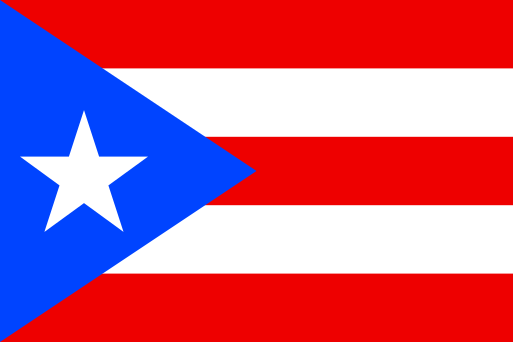
North America · Latin America and the Caribbean · Americas
PR · PRI
- Capital
- San Juan
- Population
- 3,203,295
- Area
- 8,870 km²
- Democracy index
- 75
- Regime type
- Fragmented Democracy
Commonwealth of Puerto Rico
North America · Latin America and the Caribbean · Americas
PR · PRI
Events
The latest elections, referendums, and opinion polls from Puerto Rico. Community totals are not official results.
No public ballots yet
Check back later or explore the global feed.
Classification
The score and regime label are assigned by Porto Voto using our in-house democracy index and classification framework, not ratings from governments or external agencies.
Democracy index
75/100
Regime type
Fragmented Democracy
As an unincorporated territory of the United States, Puerto Rico operates within a democratic framework characterized by regular elections, a constitutionally defined separation of powers, and robust protections for civil liberties. However, the island's unique political status creates a persistent governance friction, as the local government is subject to oversight by the Financial Oversight and Management Board, an entity appointed by the United States federal government to manage the island's fiscal recovery. This arrangement complicates local democratic accountability and contributes to deep political polarization regarding the territory's future status. While elections are competitive and the rule of law is generally upheld, public trust in local institutions is often strained by economic challenges, long standing corruption concerns, and the limitations on self governance inherent in the current colonial structure, which prevents the territory from achieving full democratic parity with the states.
Last evaluation:
How we classify regimes →World Factbook
A concise introduction to Puerto Rico, together with notes on how power and law are organized, to put local ballots in context.
Populated for centuries by aboriginal peoples, Puerto Rico was claimed by the Spanish Crown in 1493 after Christopher COLUMBUS' second voyage to the Americas. In 1898, after 400 years of colonial rule that saw the indigenous population nearly exterminated and African slave labor introduced, Puerto Rico was ceded to the US as a result of the Spanish-American War. Puerto Ricans were granted US citizenship in 1917.
Popularly elected governors have served since 1948. In 1952, a constitution was enacted that provided for internal self-government. In plebiscites held in 1967, 1993, and 1998, voters chose not to alter the existing political status with the US, but the results of a 2012 vote left open the possibility of American statehood.
A referendum held in late 2020 showed a narrow preference for statehood. Economic recession on the island has led to a net population loss since about 2005, as large numbers of residents moved to the US mainland. In 2017, Hurricane Maria was the worst storm to hit the island in eight decades, and damage was estimated in the tens of billions of dollars.