

Country profile
Pitcairn
Pitcairn, Henderson, Ducie, and Oeno Islands
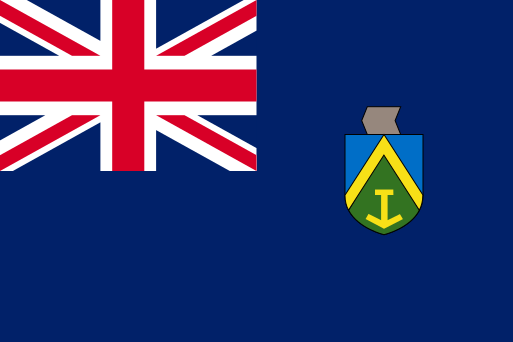
Oceania · Polynesia
PN · PCN
- Capital
- Adamstown
- Population
- 35
- Area
- 47 km²
- Democracy index
- 88
- Regime type
- Robust Democracy
Pitcairn, Henderson, Ducie, and Oeno Islands
Oceania · Polynesia
PN · PCN
Events
The latest elections, referendums, and opinion polls from Pitcairn. Community totals are not official results.
No public ballots yet
Check back later or explore the global feed.
Classification
The score and regime label are assigned by Porto Voto using our in-house democracy index and classification framework, not ratings from governments or external agencies.
Democracy index
88/100
Regime type
Robust Democracy
As a British Overseas Territory, Pitcairn Islands operates under a robust framework of governance that integrates local democratic participation with the constitutional standards of the United Kingdom. While the scale of its governance is unique due to its extremely small population, the territory maintains a high degree of administrative transparency, protected civil liberties, and a functional rule of law. The islanders exercise self determination through the Island Council, and the electoral processes are characterized by community stability rather than the polarization often seen in larger nations. Judicial integrity is maintained through links to the British legal system, ensuring that rights are protected and that governance remains accountable to both the local population and the overarching constitutional requirements of the territory status.
Last evaluation:
How we classify regimes →World Factbook
A concise introduction to Pitcairn, together with notes on how power and law are organized, to put local ballots in context.
Polynesians were the first settlers on the four tiny islands that are now called the Pitcairn Islands, but all four were uninhabited by the time Europeans discovered them in 1606. Pitcairn Island -- the only one now inhabited -- was rediscovered by a British explorer in 1767. In 1789, Fletcher CHRISTIAN led a mutiny on the HMS Bounty, and after several months of searching for Pitcairn Island, he landed on it with eight other mutineers and their Tahitian companions.
They lived in isolation and evaded detection by English authorities until 1808, when only one man, 10 women, and 23 children remained. In 1831, with the population of 87 proving too big for the island, the British attempted to move all the islanders to Tahiti, but they were soon returned to Pitcairn Island. The island became an official British colony in 1838, and in 1856, the British again determined that the population of 193 was too high and relocated all the residents to Norfolk Island.
Several families returned in 1858 and 1864, bringing the island’s population to 43, and almost all of the island’s current population are descendants of these returnees. The UK annexed the nearby uninhabited islands of Henderson, Oeno, and Ducie in 1902 and incorporated them into the Pitcairn Islands colony in 1938. The population peaked at 233 in 1937 as outmigration, primarily to New Zealand, has since thinned the population.
Only two children were born between 1986 and 2012, and in 2005, a couple became the first outsiders to obtain citizenship in more than a century. Since 2013, the Pitcairn Islands has tried to attract new migrants but has had no applicants because it requires prospective migrants to front significant sums of money and prohibits employment during a two-year trial period, at which point the local council can deny long-term resident status.