

Country profile
Peru
República del Perú
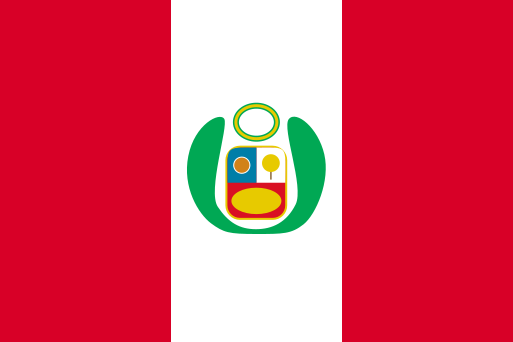
South America · Latin America and the Caribbean · Americas
PE · PER
- Capital
- Lima
- Population
- 34,350,244
- Area
- 1,285,216 km²
- Democracy index
- 58
- Regime type
- Hybrid Regime
República del Perú
South America · Latin America and the Caribbean · Americas
PE · PER
Events
The latest elections, referendums, and opinion polls from Peru. Community totals are not official results.
No public ballots yet
Check back later or explore the global feed.
Classification
The score and regime label are assigned by Porto Voto using our in-house democracy index and classification framework, not ratings from governments or external agencies.
Democracy index
58/100
Regime type
Hybrid Regime
Peru continues to struggle with severe political instability and a breakdown in consensus between the executive and legislative branches. The impeachment of successive presidents and subsequent protest movements have left the political landscape fragmented, with public confidence in democratic institutions reaching historic lows. While the electoral machinery remains functional, the political system is increasingly characterized by transactional alliances, weak party structures, and the persistent influence of patronage networks that hinder systemic reform. Judicial independence remains under pressure from legislative initiatives aimed at curbing oversight bodies, and the space for civil society is often constrained by a climate of intense social unrest and sporadic state responses. These structural weaknesses, combined with high levels of corruption and a polarized electorate, place the country in a precarious position where the institutions of democracy persist but lack the stability and legitimacy necessary to govern effectively.
Last evaluation:
How we classify regimes →World Factbook
A concise introduction to Peru, together with notes on how power and law are organized, to put local ballots in context.
Ancient Peru was the seat of several prominent Andean civilizations, most notably that of the Incas whose empire was captured by Spanish conquistadors in 1533. Peru declared its independence in 1821, and remaining Spanish forces were defeated in 1824. After a dozen years of military rule, Peru returned to democratic leadership in 1980 but experienced economic problems and the growth of a violent insurgency.
President Alberto FUJIMORI's election in 1990 ushered in a decade that saw a dramatic turnaround in the economy and significant progress in curtailing guerrilla activity. Nevertheless, an economic slump and the president's increasing reliance on authoritarian measures in the late 1990s generated mounting dissatisfaction with his regime, which led to his resignation in 2000. A caretaker government oversaw a new election in 2001 that installed Alejandro TOLEDO Manrique as the new head of government - Peru's first democratically elected president of indigenous ethnicity.
The presidential election of 2006 saw the return of Alan GARCIA Perez who, after a disappointing presidential term from 1985 to 1990, presided over a robust economic rebound. Former army officer Ollanta HUMALA Tasso was elected president in 2011 and carried on the market-oriented economic policies of the three preceding administrations. Pedro Pablo KUCZYNSKI Godard won a very narrow runoff in the 2016 presidential election.
Facing impeachment after evidence surfaced of his involvement in a vote-buying scandal, KUCZYNSKI offered his resignation in 2018, and First Vice President Martin Alberto VIZCARRA Cornejo was sworn in as president. In 2019, VIZCARRA invoked his constitutional authority to dissolve Peru's Congress after months of battling with the body over anticorruption reforms. New congressional elections in 2020 resulted in an opposition-led legislature.
The Congress impeached VIZCARRA for a second time and removed him from office after accusations of corruption and mishandling of the COVID-19 pandemic. Because of vacancies in the vice-presidential positions, the President of the Peruvian Congress, Manuel MERINO, became the next president. His ascension to office was not well received, and large protests forced his resignation later in 2020.
Francisco SAGASTI assumed the position of President of Peru after being appointed President of the Congress the previous day. Jose Pedro CASTILLO Terrones won presidential election in 2021 but was impeached and ousted the following year; his vice president, Dina BOLUARTE, assumed the presidency by constitutional succession in 2022.