

Country profile
Papua New Guinea
Independent State of Papua New Guinea
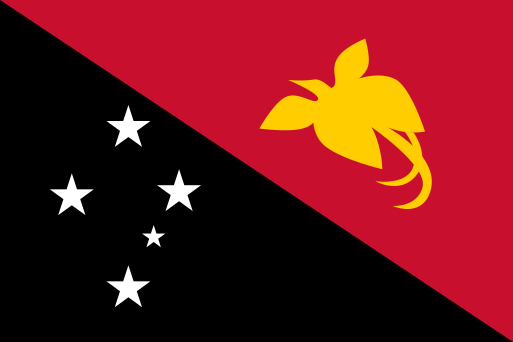
Oceania · Melanesia
PG · PNG
- Capital
- Port Moresby
- Population
- 11,781,559
- Area
- 462,840 km²
- Democracy index
- 71
- Regime type
- Fragmented Democracy
Independent State of Papua New Guinea
Oceania · Melanesia
PG · PNG
Events
The latest elections, referendums, and opinion polls from Papua New Guinea. Community totals are not official results.
No public ballots yet
Check back later or explore the global feed.
Classification
The score and regime label are assigned by Porto Voto using our in-house democracy index and classification framework, not ratings from governments or external agencies.
Democracy index
71/100
Regime type
Fragmented Democracy
Papua New Guinea maintains a constitutional democracy characterized by regular multi-party elections, yet the political environment remains structurally unstable due to a pervasive culture of clientelism, localized power bases, and frequent motions of no confidence in the national parliament. While the electoral process facilitates genuine competition, the implementation of public policy is often impeded by the necessity of managing fragile legislative coalitions, which frequently leads to governance inertia. Concerns regarding judicial independence and the integrity of the electoral commission persist, although the judiciary has periodically demonstrated resilience in upholding legal standards against executive overreach. Civil liberties remain largely protected, yet the effective exercise of rights is often undermined by limited state reach, recurring instances of communal violence, and pervasive corruption that complicates the delivery of public services to the broader population.
Last evaluation:
How we classify regimes →World Factbook
A concise introduction to Papua New Guinea, together with notes on how power and law are organized, to put local ballots in context.
Papua New Guinea (PNG) occupies the eastern half of the island of New Guinea; the western half is part of Indonesia. PNG was first settled between 50,000 and 60,000 years ago. Its harsh geography of mountains, jungles, and numerous river valleys kept many of the arriving groups isolated, giving rise to PNG’s ethnic and linguistic diversity.
Around 500 B.C., Austronesian voyagers settled along the coast. Spanish and Portuguese explorers periodically visited the island starting in the 1500s, but none made it into the country’s interior. American and British whaling ships frequented the islands off the coast of New Guinea in the mid-1800s.
In 1884, Germany declared a protectorate -- and eventually a colony -- over the northern part of what would become PNG and named it German New Guinea; days later the UK followed suit on the southern part and nearby islands and called it Papua. Most of their focus was on the coastal regions, leaving the highlands largely unexplored. The UK put its colony under Australian administration in 1902 and formalized the act in 1906.
At the outbreak of World War I, Australia occupied German New Guinea and continued to rule it after the war as a League of Nations Mandate. The discovery of gold along the Bulolo River in the 1920s led prospectors to venture into the highlands, where they found about 1 million people living in isolated communities. The New Guinea campaign of World War II lasted from January 1942 to the Japanese surrender in August 1945.
After the war, Australia combined the two territories and administered PNG as a UN trusteeship. In 1975, PNG gained independence and became a member of the Commonwealth. Between 1988-1997, a secessionist movement on the island province of Bougainville, located off the eastern PNG coast, fought the PNG Government, resulting in 15,000-20,000 deaths.
In 1997, the PNG Government and Bougainville leaders reached a cease-fire and subsequently signed a peace agreement in 2001. The Autonomous Bougainville Government was formally established in 2005. Bougainvilleans voted in favor of independence in a 2019 non-binding referendum.
The Bougainville and PNG governments are in the process of negotiating a roadmap for independence, which requires approval by the PNG parliament.