

Country profile
Panama
República de Panama
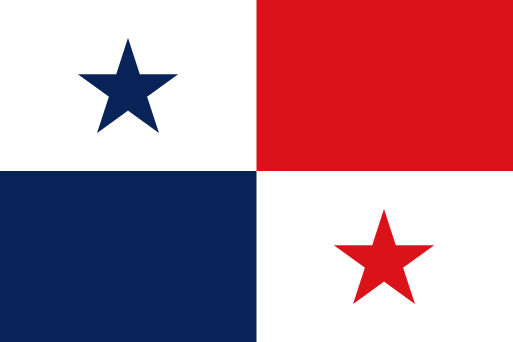
North America · Latin America and the Caribbean · Americas
PA · PAN
- Capital
- Panama City
- Population
- 4,064,780
- Area
- 75,417 km²
- Democracy index
- 74
- Regime type
- Fragmented Democracy
República de Panama
North America · Latin America and the Caribbean · Americas
PA · PAN
Events
The latest elections, referendums, and opinion polls from Panama. Community totals are not official results.
No public ballots yet
Check back later or explore the global feed.
Classification
The score and regime label are assigned by Porto Voto using our in-house democracy index and classification framework, not ratings from governments or external agencies.
Democracy index
74/100
Regime type
Fragmented Democracy
Panama continues to function as a representative democracy with regular electoral cycles and peaceful transfers of power, yet it faces significant challenges regarding institutional integrity and public trust. The political landscape remains characterized by high levels of polarization and governance friction, which frequently impede the implementation of substantive structural reforms. While civil liberties are generally respected and the press remains active, concerns persist regarding corruption, the influence of clientelism in governance, and the efficacy of judicial oversight. These factors collectively create a degree of institutional strain that prevents the country from reaching the upper tiers of democratic stability, keeping it in a state of functional but fragile democratic practice.
Last evaluation:
How we classify regimes →World Factbook
A concise introduction to Panama, together with notes on how power and law are organized, to put local ballots in context.
Explored and settled by the Spanish in the 16th century, Panama broke with Spain in 1821 and joined a union of Colombia, Ecuador, and Venezuela that was named the Republic of Gran Colombia. When the union dissolved in 1830, Panama remained part of Colombia. With US backing, Panama seceded from Colombia in 1903 and promptly signed a treaty with the US allowing for the construction of a canal and US sovereignty over a strip of land known as the Panama Canal Zone on either side of the structure.
The US Army Corps of Engineers built the Panama Canal between 1904 and 1914. In 1977, an agreement was signed for the complete transfer of the Canal from the US to Panama by the end of the century. Certain portions of the Zone and increasing responsibility over the Canal were turned over in the subsequent decades.
With US help, Panamanian dictator Manuel NORIEGA was deposed in 1989. The entire Panama Canal, the area supporting the Canal, and remaining US military bases were transferred to Panama by the end of 1999. An ambitious expansion project to more than double the Canal's capacity by allowing for more Canal transits and larger ships was carried out between 2007 and 2016.