

Country profile
Pakistan
Jamhuryat Islami Pakistan
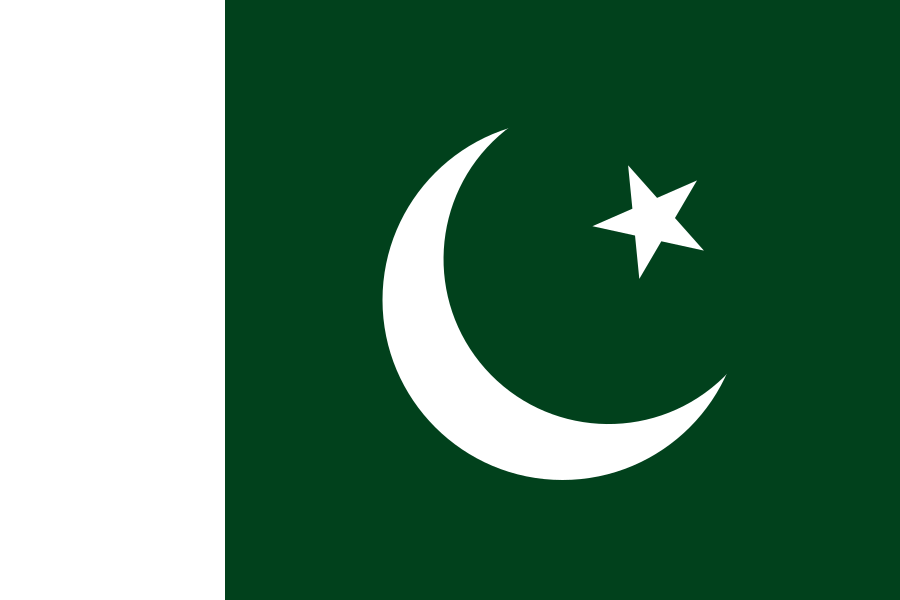
Asia · Southern Asia
PK · PAK
- Capital
- Islamabad
- Population
- 241,499,431
- Area
- 796,095 km²
- Democracy index
- 34
- Regime type
- Electoral Autocracy
Jamhuryat Islami Pakistan
Asia · Southern Asia
PK · PAK
Events
The latest elections, referendums, and opinion polls from Pakistan. Community totals are not official results.
No public ballots yet
Check back later or explore the global feed.
Classification
The score and regime label are assigned by Porto Voto using our in-house democracy index and classification framework, not ratings from governments or external agencies.
Democracy index
34/100
Regime type
Electoral Autocracy
Pakistan functions as an electoral autocracy where a civilian government, led by Prime Minister Shehbaz Sharif, manages daily administration under heavy influence from the powerful military establishment. While multi party elections occur, the political field remains heavily skewed through targeted judicial pressure and the systematic curbing of opposition elements, particularly the Pakistan Tehreek e Insaf party. The state apparatus closely monitors political dissent, restricts civil liberties, and implements strict regulatory measures on the media and digital spaces. Structural governance challenges are exacerbated by ongoing fiscal crises, causing the state to enforce aggressive revenue collections and structural reforms linked to International Monetary Fund commitments. Judicial independence is frequently compromised by institutional friction and external pressure, resulting in an uneven rule of law where legal mechanisms are often applied selectively against political opponents.
Last evaluation:
How we classify regimes →World Factbook
A concise introduction to Pakistan, together with notes on how power and law are organized, to put local ballots in context.
The Indus Valley civilization, one of the oldest in the world and dating back at least 5,000 years, spread over much of modern-day Pakistan. During the second millennium B.C., remnants of this culture fused with the migrating Indo-Aryan peoples. The area underwent successive invasions in subsequent centuries from the Persians, Greeks, Scythians, Arabs (who brought Islam), Afghans, and Turks.
The Mughal Empire flourished in the 16th and 17th centuries; the British came to dominate the region in the 18th century. The partition in 1947 of British India into the Muslim state of Pakistan (with West and East sections) and largely Hindu India created lasting tension between the two countries. They have fought two wars and a limited conflict -- in 1947-48, 1965, and 1999 respectively -- over the Kashmir territory, a dispute that continues to this day.
A third war in 1971 -- in which India assisted an indigenous movement reacting to Bengali marginalization in Pakistani politics -- resulted in East Pakistan becoming the separate nation of Bangladesh. In response to Indian nuclear weapons testing, Pakistan conducted its own tests in 1998. Pakistan has been engaged in a decades-long armed conflict with militant groups, including the Tehreek-e-Taliban Pakistan (TTP) and other militant networks that target government institutions and civilians.