

Country profile
Norfolk Island
Territory of Norfolk Island
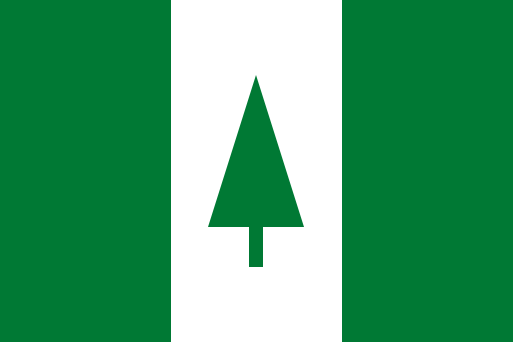
Oceania · Australia and New Zealand
NF · NFK
- Capital
- Kingston
- Population
- 2,188
- Area
- 36 km²
- Democracy index
- 72
- Regime type
- Fragmented Democracy
Territory of Norfolk Island
Oceania · Australia and New Zealand
NF · NFK
Events
The latest elections, referendums, and opinion polls from Norfolk Island. Community totals are not official results.
No public ballots yet
Check back later or explore the global feed.
Classification
The score and regime label are assigned by Porto Voto using our in-house democracy index and classification framework, not ratings from governments or external agencies.
Democracy index
72/100
Regime type
Fragmented Democracy
Norfolk Island, an external territory of Australia, operates within a fragmented democratic framework due to ongoing institutional friction and a prolonged suspension of full local self governance. Following the dissolution of its regional parliament by the Australian federal government in 2015, the territory has been managed primarily through an appointed administrator and an advisory council, rather than fully autonomous local representatives. Basic civil liberties, human rights, and the rule of law are robustly protected under the overarching Australian legal system, and residents participate freely in Australian federal elections. However, localized democracy remains under severe strain, characterized by widespread civic discontent and an active self determination movement led by local elders. In early 2026, community organized local voting initiatives highlighted the deep rift between residents wanting restored autonomy and the federal government's controlled transitional plans. While Canberra recently detailed a new five member local assembly framework to restore municipal level democracy, its scope is restricted to local government regulations, which leaves the structural distribution of territorial power highly asymmetric and places the local political environment in a persistent state of institutional deadlock.
Last evaluation:
How we classify regimes →World Factbook
A concise introduction to Norfolk Island, together with notes on how power and law are organized, to put local ballots in context.
Polynesians lived on Norfolk Island between 1200 and 1500, but the remote island was uninhabited by the time British explorer James COOK landed on the island in 1774. Two British attempts at establishing the island as a penal colony (1788-1814 and 1825-55) were ultimately abandoned. In 1856, almost 200 Pitcairn Islanders -- descendants of the Bounty mutineers and their Tahitian companions -- were relocated to Norfolk Island because of overcrowding on the Pitcairn Islands.
Some returned to the Pitcairn Islands over the next few years, but most settled permanently on Norfolk Island and recreated their previous land tenure and governance structures. Norfolk Island retained a great degree of local control until 1897, when it became a dependency of New South Wales. During World War II, Norfolk Island was an airbase and an important refueling stop in the South Pacific.
In 1976, an Australian judge recommended Norfolk Island be incorporated fully into Australia, which Norfolk Islanders rejected. After an appeal to the UN, Australia granted limited self-government to Norfolk Island in 1979. With growing financial troubles during the 2000s, Australia abolished the Norfolk Island Legislative Assembly in 2015, reduced Norfolk Island’s autonomy in 2016, and suspended the local council in 2020.
Most services are provided by a mix of the Australian Capital Territory and the states of New South Wales and Queensland. These moves were unpopular on Norfolk Island, which has sought to have its self-government restored and as of 2024, the Australian Government was working with Norfolk Island to establish a new local governing body.