

Country profile
Nicaragua
República de Nicaragua
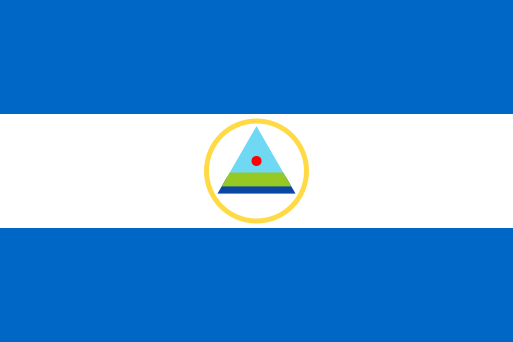
North America · Latin America and the Caribbean · Americas
NI · NIC
- Capital
- Managua
- Population
- 6,803,886
- Area
- 130,373 km²
- Democracy index
- 9
- Regime type
- Closed Autocracy
República de Nicaragua
North America · Latin America and the Caribbean · Americas
NI · NIC
Events
The latest elections, referendums, and opinion polls from Nicaragua. Community totals are not official results.
No public ballots yet
Check back later or explore the global feed.
Classification
The score and regime label are assigned by Porto Voto using our in-house democracy index and classification framework, not ratings from governments or external agencies.
Democracy index
9/100
Regime type
Closed Autocracy
Nicaragua functions under a deeply entrenched closed autocracy dominated by President Daniel Ortega and Vice President Rosario Murillo, who was formally elevated to the status of co-president following expansive constitutional reforms in 2025. The political environment is devoid of genuine competition or democratic checks, as the ruling Sandinista National Liberation Front exercises total control over the legislature, the judiciary, and electoral authorities. Genuine political opposition has been systematically eliminated through the arbitrary arrest, imprisonment, and forced exile of critical voices, many of whom have been stripped of their nationality under new legal provisions. Civil liberties, independent journalism, and religious freedom are aggressively suppressed, while the formal institutionalization of paramilitary groups as a volunteer police force further expands the state apparatus of domestic surveillance and intimidation. While the regime occasionally releases small groups of political detainees as a diplomatic gesture, the systemic legal framework operates solely to criminalize political dissent and preserve the executive family monopoly on power.
Last evaluation:
How we classify regimes →World Factbook
A concise introduction to Nicaragua, together with notes on how power and law are organized, to put local ballots in context.
The Pacific coast of Nicaragua was settled as a Spanish colony in the early 16th century. Independence from Spain was declared in 1821, and the country became an independent republic in 1838. Britain occupied the Caribbean Coast in the first half of the 19th century, but gradually ceded control of the region in subsequent decades.
By 1978, violent opposition to governmental manipulation and corruption resulted in a short-lived civil war that brought a civil-military coalition to power in 1979, spearheaded by Marxist Sandinista guerrillas led by Daniel ORTEGA Saavedra. Nicaraguan aid to leftist rebels in El Salvador prompted the US to sponsor anti-Sandinista Contra guerrillas through much of the 1980s. After losing free and fair elections in 1990, 1996, and 2001, ORTEGA was elected president in 2006, 2011, 2016, and most recently in 2021.
Municipal, regional, and national-level elections since 2008 have been marred by widespread irregularities. Democratic institutions have lost their independence under the ORTEGA regime as the president has assumed full control over all branches of government, as well as cracking down on a nationwide pro-democracy protest movement in 2018 and shuttering over 3,300 civil society organizations between 2018 and 2024. In the lead-up to the 2021 presidential election, authorities arrested over 40 individuals linked to the opposition, including presidential candidates, private sector leaders, NGO workers, human rights defenders, and journalists.
Only five lesser-known presidential candidates from mostly small parties allied to ORTEGA's Sandinistas were allowed to run against ORTEGA. He then awarded the Sandinistas control of all 153 of Nicaraguan municipalities in the 2022 municipal elections, consolidating one-party rule.