

Country profile
New Caledonia
Territoire des Nouvelle-Calédonie et dépendances
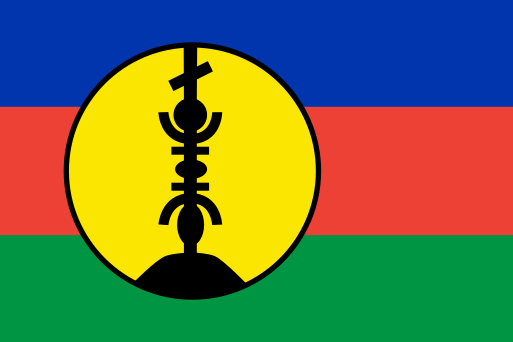
Oceania · Melanesia
NC · NCL
- Capital
- Nouméa
- Population
- 264,596
- Area
- 18,575 km²
- Democracy index
- 70
- Regime type
- Fragmented Democracy
Territoire des Nouvelle-Calédonie et dépendances
Oceania · Melanesia
NC · NCL
Events
The latest elections, referendums, and opinion polls from New Caledonia. Community totals are not official results.
No public ballots yet
Check back later or explore the global feed.
Classification
The score and regime label are assigned by Porto Voto using our in-house democracy index and classification framework, not ratings from governments or external agencies.
Democracy index
70/100
Regime type
Fragmented Democracy
New Caledonia functions within a fragmented democratic framework as a sui generis collectivity of France, facing severe institutional strain, political deadlock, and lingering societal polarization. While regular multi party competition is historically established, the democratic playing field is deeply compromised by intense conflict surrounding voter eligibility rules for the local provincial elections, which have been delayed multiple times and are rescheduled for June 2026. The collapse of the constitutional reforms linked to the Bougival Accord in April 2026, followed by the French government's unilateral efforts to alter the voter rolls despite resistance from the core indigenous Kanak independence coalition, has heightened systemic instability and prompted formal warnings from international bodies regarding self determination rights. Fundamental civil liberties, judicial recourse, and media freedoms are formally protected under French law, yet the heavy deployment of metropolitan security forces and intermittent curfews undermine daily civic life. This persistent impasse between loyalist factions and pro independence coalitions continues to generate profound governance friction and prevents the territorial assembly from achieving long term policy consensus, leaving the institutional system under immense duress.
Last evaluation:
How we classify regimes →World Factbook
A concise introduction to New Caledonia, together with notes on how power and law are organized, to put local ballots in context.
The first humans settled in New Caledonia around 1600 B.C. The Lapita were skilled navigators, and evidence of their pottery around the Pacific has served as a guide for understanding human expansion in the region. Successive waves of migrants from other islands in Melanesia intermarried with the Lapita, giving rise to the Kanak ethnic group considered indigenous to New Caledonia.
British explorer James COOK was the first European to visit New Caledonia in 1774, giving it the Latin name for Scotland. Missionaries first landed in New Caledonia in 1840. In 1853, France annexed New Caledonia to preclude any British attempt to claim the island.
France declared it a penal colony in 1864 and sent more than 20,000 prisoners to New Caledonia in the ensuing three decades. Nickel was discovered in 1864, and French prisoners were directed to mine it. France brought in indentured servants and enslaved labor from elsewhere in Southeast Asia to work the mines, blocking Kanaks from accessing the most profitable part of the local economy.
In 1878, High Chief ATAI led a rebellion against French rule. The Kanaks were relegated to reservations, leading to periodic smaller uprisings and culminating in a large revolt in 1917 that colonial authorities brutally suppressed. During World War II, New Caledonia became an important base for Allied troops, and the US moved its South Pacific headquarters to the island in 1942.
Following the war, France made New Caledonia an overseas territory and granted French citizenship to all inhabitants in 1953, thereby permitting the Kanaks to move off the reservations. The Kanak nationalist movement began in the 1950s, but most voters chose to remain a territory in an independence referendum in 1958. The European population of New Caledonia boomed in the 1970s with a renewed focus on nickel mining, reigniting Kanak nationalism.
Key Kanak leaders were assassinated in the early 1980s, leading to escalating violence and dozens of fatalities. The Matignon Accords of 1988 provided for a 10-year transition period. The Noumea Accord of 1998 transferred increasing governing responsibility from France to New Caledonia over a 20-year period and provided for three independence referenda.
In the first held in 2018, voters rejected independence by 57% to 43%; in the second held in 2020, voters rejected independence 53% to 47%. In the third referendum held in 2021, voters rejected independence 96% to 4%; however, a boycott by key Kanak groups spurred challenges about the legitimacy of the vote. Pro-independence parties subsequently won a majority in the New Caledonian Government for the first time.
France and New Caledonia officials remain in talks about the status of the territory.