

Country profile
Mongolia
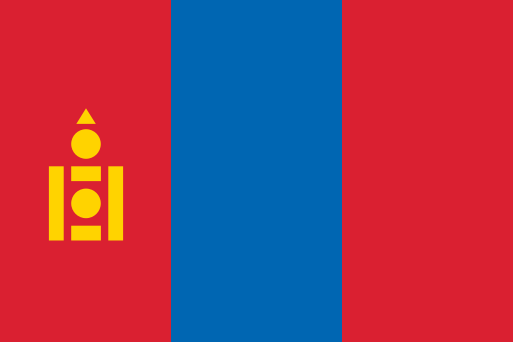
Asia · Eastern Asia
MN · MNG
- Capital
- Ulan Bator
- Population
- 3,544,835
- Area
- 1,564,110 km²
- Democracy index
- 73
- Regime type
- Fragmented Democracy
Asia · Eastern Asia
MN · MNG
Events
The latest elections, referendums, and opinion polls from Mongolia. Community totals are not official results.
No public ballots yet
Check back later or explore the global feed.
Classification
The score and regime label are assigned by Porto Voto using our in-house democracy index and classification framework, not ratings from governments or external agencies.
Democracy index
73/100
Regime type
Fragmented Democracy
Mongolia functions as a competitive multi party democracy with a strong history of peaceful electoral successions and a genuine commitment to civil liberties, yet the system currently experiences significant governance friction and political instability. The democratic framework has faced major strain due to rapid transitions within the executive leadership, marked by the appointment of three different prime ministers within a single twelve month period. This rapid turnover and executive fluidity, culminating in the ascension of Nyam-Osor Uchral following the resignation of Gombojav Zandanshatar amid parliamentary boycotts and economic uncertainties, highlight deep institutional volatility. While political competition remains active and pluralistic with several factions preparing for future national contests, this ongoing political instability compromises long term policy coherence and public transparency. Media outlets and civil society groups continue to operate and express dissent, but ongoing discussions regarding media law reform underscore a pressing need to safeguard journalistic independence from state pressure, leaving the state within the lower tier of a functional but fragmented democratic system.
Last evaluation:
How we classify regimes →World Factbook
A concise introduction to Mongolia, together with notes on how power and law are organized, to put local ballots in context.
The peoples of Mongolia have a long history under a number of nomadic empires dating back to the Xiongnu in the 4th century B.C., and the name Mongol goes back to at least the 11th century A.D. The most famous Mongol, TEMÜÜJIN (aka Genghis Khan), emerged as the ruler of all Mongols in the early 1200s. By the time of his death in 1227, he had created through conquest a Mongol Empire that extended across much of Eurasia.
His descendants, including ÖGÖDEI and KHUBILAI (aka Kublai Khan), continued to conquer Eastern Europe, the Middle East, and the rest of China, where KHUBILAI established the Yuan Dynasty in the 1270s. The Mongols attempted to invade Japan and Java before their empire broke apart in the 14th century. In the 17th century, Mongolia fell under the rule of the Manchus of the Chinese Qing Dynasty.
After Manchu rule collapsed in 1911, Mongolia declared independence, finally winning it in 1921 with help from the Soviet Union. Mongolia became a socialist state (the Mongolian People’s Republic) in 1924. Until the collapse of the Soviet Union in 1989, Mongolia was a Soviet satellite state and relied heavily on economic, military, and political assistance from Moscow.
The period was also marked by purges, political repression, economic stagnation, and tensions with China. Mongolia peacefully transitioned to an independent democracy in 1990. In 1992, it adopted a new constitution and established a free-market economy.
Since the country's transition, it has conducted a series of successful presidential and legislative elections. Throughout the period, the ex-communist Mongolian People's Revolutionary Party -- which took the name Mongolian People’s Party (MPP) in 2010 -- has competed for political power with the Democratic Party and several other smaller parties. For most of its democratic history, Mongolia has had a divided government, with the presidency and the parliamentary majority held by different parties but that changed in 2021, when the MPP won the presidency after having secured a supermajority in parliament in 2020.
Mongolia’s June 2021 presidential election delivered a decisive victory for MPP candidate Ukhnaagiin KHURELSUKH. Mongolia maintains close cultural, political, and military ties with Russia, while China is its largest economic partner. Mongolia’s foreign relations are focused on preserving its autonomy by balancing relations with China and Russia, as well as its other major partners, Japan, South Korea, and the US.