

Country profile
Micronesia, Federated States of
Federated States of Micronesia
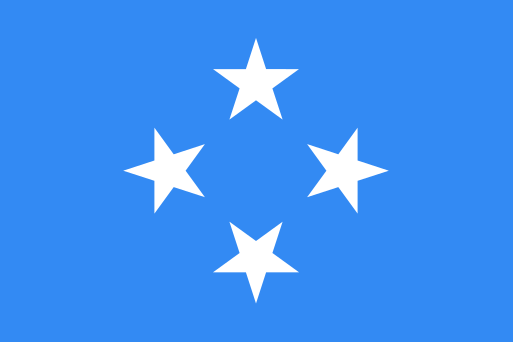
Oceania · Micronesia
FM · FSM
- Capital
- Palikir
- Population
- 105,564
- Area
- 702 km²
- Democracy index
- 89
- Regime type
- Robust Democracy
Federated States of Micronesia
Oceania · Micronesia
FM · FSM
Events
The latest elections, referendums, and opinion polls from Micronesia, Federated States of. Community totals are not official results.
No public ballots yet
Check back later or explore the global feed.
Classification
The score and regime label are assigned by Porto Voto using our in-house democracy index and classification framework, not ratings from governments or external agencies.
Democracy index
89/100
Regime type
Robust Democracy
The Federated States of Micronesia functions as a stable and peaceful parliamentary democracy with a commendable record of civil liberties, political pluralism, and transparent legislative successions. The national political structure operates without formal political parties, as candidates run for the unicameral Congress entirely as independents, shifting governance into a system of loose regional coalitions and fluid legislative dynamics. Freedom of expression, journalistic independence, and civil society operations are thoroughly respected under a fully functional constitutional framework, while an autonomous judiciary consistently enforces the rule of law. National cohesion face real strains due to deep political friction, subnational administrative disputes, and geopolitical maneuvering across the Pacific region, leading President Wesley Simina to express formal concern in May 2026 over growing domestic polarization that threatens to test the core institutional fabric of the federation. Nevertheless, fundamental human rights remain highly secure, political processes remain transparent and open to public accountability, and institutional paths to power continue to rely strictly on the rule of law.
Last evaluation:
How we classify regimes →World Factbook
A concise introduction to Micronesia, Federated States of, together with notes on how power and law are organized, to put local ballots in context.
Each of the four states that compose the Federated States of Micronesia (FSM) -- Chuuk, Kosrae, Pohnpei, and Yap -- has its own unique history and cultural traditions. The first humans arrived in what is now the FSM in the second millennium B.C. In the 800s A.D., construction of the artificial islets at the Nan Madol complex in Pohnpei began, with the main architecture being built around 1200.
At its height, Nan Madol united the approximately 25,000 people of Pohnpei under the Saudeleur Dynasty. By 1250, Kosrae was united in a kingdom centered in Leluh. Yap’s society became strictly hierarchical, with chiefs receiving tributes from islands up to 1,100 km (700 mi) away.
Widespread human settlement in Chuuk began in the 1300s, and the different islands in the Chuuk Lagoon were frequently at war with one another. Portuguese and Spanish explorers visited a few of the islands in the 1500s, and Spain began exerting nominal, but not day-to-day, control over some of the islands -- which they named the Caroline Islands -- in the 1600s. In 1899, Spain sold all of the FSM to Germany.
Japan seized the islands in 1914 and was granted a League of Nations mandate to administer them in 1920. During WWII, Japan built military bases across most of the islands and headquartered their Pacific naval operations in Chuuk. The US bombed Chuuk in 1944 but largely bypassed the other islands in its leapfrog campaign across the Pacific.
In 1947, the FSM came under US administration as part of the Trust Territory of the Pacific Islands, which comprised six districts: Chuuk, the Marshall Islands, the Northern Mariana Islands, Palau, Pohnpei, and Yap; Kosrae was separated from Pohnpei into a separate district in 1977. In 1979, Chuuk, Kosrae, Pohnpei, and Yap ratified the FSM Constitution and declared independence while the other three districts opted to pursue separate political status. There are significant inter-island rivalries stemming from their different histories and cultures.
Chuuk, the most populous but poorest state, has pushed for secession, but an independence referendum has been repeatedly postponed.