

Country profile
Mauritania
Al Jumhuriyah al Islamiyah al Muritaniyah
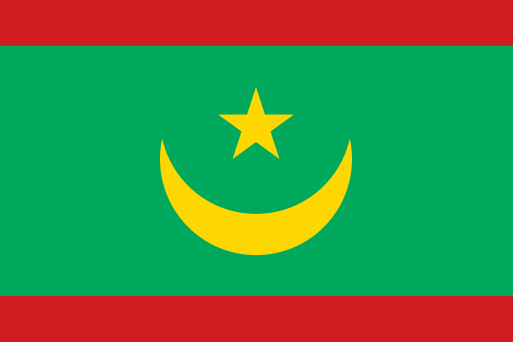
Africa · Sub-Saharan Africa
MR · MRT
- Capital
- Nouakchott
- Population
- 4,927,532
- Area
- 1,030,700 km²
- Democracy index
- 41
- Regime type
- Electoral Autocracy
Al Jumhuriyah al Islamiyah al Muritaniyah
Africa · Sub-Saharan Africa
MR · MRT
Events
The latest elections, referendums, and opinion polls from Mauritania. Community totals are not official results.
No public ballots yet
Check back later or explore the global feed.
Classification
The score and regime label are assigned by Porto Voto using our in-house democracy index and classification framework, not ratings from governments or external agencies.
Democracy index
41/100
Regime type
Electoral Autocracy
Mauritania maintains the formal structures of a multi party system, highlighted by presidential elections that returned incumbent Mohamed Ould Ghazouani to office, but the executive branch dominates the political landscape. The political apparatus leverages state resources, media dominance, and a selective application of legal mechanisms to limit the effectiveness of opposition movements. The Supreme Court confirmation of a corruption conviction against former president Mohamed Ould Abdel Aziz underscores an uneven anti corruption strategy that critics argue is politically motivated. Civil liberties, journalistic expression, and freedom of assembly face ongoing institutional pressure, with authorities enacting tougher restrictions on political organizing and protests, particularly regarding migration issues and socioeconomic disparities. Although Mauritania avoids the severe military disruptions observed across other parts of the Sahel region, its democratic infrastructure functions primarily as a veneer for centralized power structures, preventing authentic political equality or independent judicial oversight.
Last evaluation:
How we classify regimes →World Factbook
A concise introduction to Mauritania, together with notes on how power and law are organized, to put local ballots in context.
The Amazigh and Bafour people were among the earliest settlers in what is now Mauritania and among the first in recorded history to convert from a nomadic to agricultural lifestyle. These groups account for roughly one third of Mauritania’s ethnic makeup. The remainder of Mauritania’s ethnic groups derive from Sub-Saharan ethnic groups originating mainly from the Senegal River Valley, including descendants of former enslaved peoples.
These three groups are organized according to a strict caste system with deep ethnic divides that impact access to resources and power dynamics. A former French colony, Mauritania achieved independence from France in 1960. Mauritania initially began as a single-party, authoritarian regime and experienced 49 years of dictatorships, flawed elections, failed attempts at democracy, and military coups.
Ould Abdel AZIZ led the last coup in 2008, was elected president in 2009, and was reelected in 2014. Mohamed Ould Cheikh GHAZOUANI was elected president in 2019, and his inauguration marked the first peaceful transition of power from one democratically elected president to another, solidifying the country's status as an emerging democracy. International observers recognized the elections as relatively free and fair.
GHAZOUANI is seeking re-election in June 2024 for a second, and final, five-year term. The country is working to address vestigial practices of slavery and its hereditary impacts. Mauritania officially abolished slavery in 1981, but the practice was not criminalized until 2007.
Between 2005 and 2011, Al-Qaeda in the Islamic Maghreb (AQIM) launched a series of attacks killing western tourists and aid workers, attacking diplomatic and government facilities, and ambushing Mauritanian soldiers and gendarmes. Although Mauritania has not seen an attack since 2011, AQIM and similar groups remain active in the Sahel region.