

Country profile
Maldives
Dhivehi Raajjeyge Jumhooriyyaa
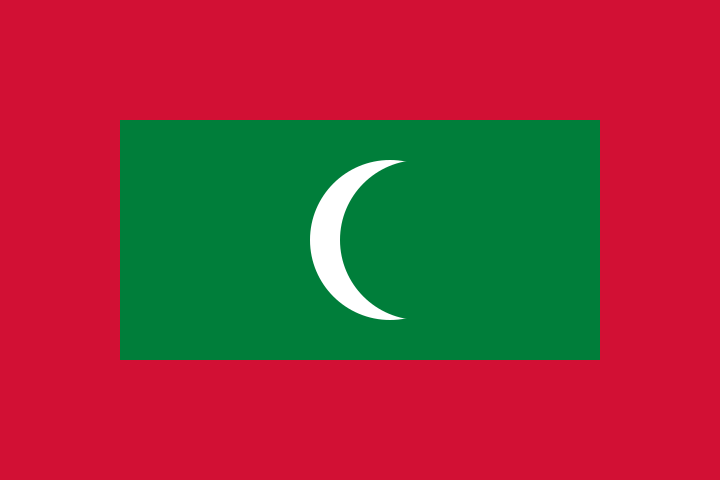
Asia · Southern Asia
MV · MDV
- Capital
- Malé
- Population
- 515,132
- Area
- 300 km²
- Democracy index
- 55
- Regime type
- Hybrid Regime
Dhivehi Raajjeyge Jumhooriyyaa
Asia · Southern Asia
MV · MDV
Events
The latest elections, referendums, and opinion polls from Maldives. Community totals are not official results.
No public ballots yet
Check back later or explore the global feed.
Classification
The score and regime label are assigned by Porto Voto using our in-house democracy index and classification framework, not ratings from governments or external agencies.
Democracy index
55/100
Regime type
Hybrid Regime
The Maldives continues to exhibit the characteristics of a hybrid regime where genuine democratic processes coexist with growing executive centralization. The political environment has become increasingly uneven following the consolidation of power by President Mohamed Muizzu and his ruling People's National Congress, which has utilized legislative supermajorities to exert pressure on independent state organs, establish stricter media regulators, and compromise judicial autonomy. Despite these systemic shifts toward executive dominance, the democratic infrastructure remains surprisingly resilient and competitive. In the nationwide local elections and constitutional referendum held on 4 April 2026, voters decisively rejected a government backed plan to merge elections and favored opposition parties in several local contests. The executive branch accepted this public rebuff, which underscores that electoral pathways remain highly viable and active. However, persistent challenges regarding police crackdowns on peaceful protests, institutional capture, and overextended public resources restrict the system from achieving structural stability or full democratic consolidation.
Last evaluation:
How we classify regimes →World Factbook
A concise introduction to Maldives, together with notes on how power and law are organized, to put local ballots in context.
A sultanate since the 12th century, the Maldives became a British protectorate in 1887 and a republic in 1968, three years after independence. President Maumoon Abdul GAYOOM dominated Maldives' political scene for 30 years, elected to six successive terms by single-party referendums. After political demonstrations in the capital Male in 2003, GAYOOM and his government pledged to embark upon a process of liberalization and democratic reforms, including a more representative political system and expanded political freedoms.
Political parties were legalized in 2005. In 2008, a constituent assembly -- termed the "Special Majlis" -- finalized a new constitution ratified by GAYOOM. The first-ever presidential elections under a multi-candidate, multi-party system were held later that year.
GAYOOM was defeated in a runoff by Mohamed NASHEED, a political activist whom the regime had jailed several years earlier. In 2012, after several weeks of street protests in response to a top judge's arrest, NASHEED resigned the presidency and handed over power to Vice President Mohammed WAHEED Hassan Maniku. A government-appointed Commission of National Inquiry concluded that there was no evidence of a coup, but NASHEED contended that police and military personnel forced him to resign.
NASHEED, WAHEED, and Abdulla YAMEEN Abdul Gayoom ran in the 2013 elections with YAMEEN ultimately winning the presidency after three rounds of voting. In 2018, YAMEEN lost his reelection bid to parliamentarian Ibrahim Mohamed SOLIH. YAMEEN was arrested and jailed in 2022 on corruption charges.
Maldives' fourth democratic election was held in September 2023. The winner, Male City Mayor Dr. Mohamed MUIZZU, campaigned on a platform of Maldivian sovereignty, vowing to remove Indian military personnel from the country.
MUIZZU represents a joint Progressive Pary of Maldives and People's National Congress (PPM/PNC) coalition.