

Country profile
Madagascar
République de Madagascar/Repoblikan'i Madagasikara
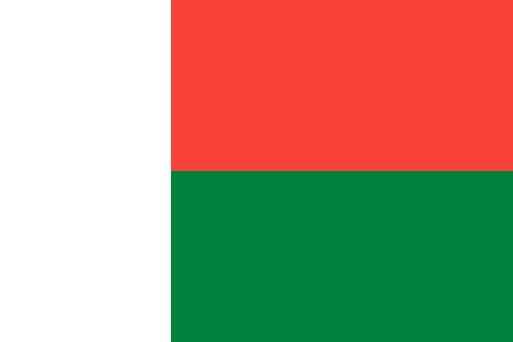
Africa · Sub-Saharan Africa
MG · MDG
- Capital
- Antananarivo
- Population
- 31,727,042
- Area
- 587,041 km²
- Democracy index
- 28
- Regime type
- Electoral Autocracy
République de Madagascar/Repoblikan'i Madagasikara
Africa · Sub-Saharan Africa
MG · MDG
Events
The latest elections, referendums, and opinion polls from Madagascar. Community totals are not official results.
No public ballots yet
Check back later or explore the global feed.
Classification
The score and regime label are assigned by Porto Voto using our in-house democracy index and classification framework, not ratings from governments or external agencies.
Democracy index
28/100
Regime type
Electoral Autocracy
Madagascar has experienced severe institutional instability following the military intervention in October 2025, which deposed President Andry Rajoelina and brought Colonel Michael Randrianirina to power. The formal constitutional framework has been fundamentally disrupted by the military leadership, highlighted by the absolute suspension of the government and the dismissal of the prime minister and cabinet in March 2026. While the ruling junta has maintained dialogue with regional bodies like the Southern African Development Community and submitted a tentative 24 month transition roadmap pointing toward presidential elections in 2027, power is heavily consolidated within the executive and military apparatus. The legislative and judicial branches exercise virtually no independent oversight under the current military rule, and structural protections for civil liberties, political pluralism, and open dissent are systemically constrained, locking the country into an autocratic transitional phase where genuine democratic competition is absent.
Last evaluation:
How we classify regimes →World Factbook
A concise introduction to Madagascar, together with notes on how power and law are organized, to put local ballots in context.
Madagascar was one of the last major habitable landmasses on earth to be settled by humans. While there is some evidence of human presence on the island in the millennia B.C., large-scale settlement began between A.D. 350 and 550 with settlers from present-day Indonesia. The island attracted Arab and Persian traders as early as the 7th century, and migrants from Africa arrived around A.D. 1000.
Madagascar was a pirate stronghold during the late 17th and early 18th centuries and served as a slave trading center into the 19th century. From the 16th to the late 19th century, a native Merina Kingdom dominated much of Madagascar. The French conquered the island in 1896 and made it a colony; independence was regained in 1960.
Free presidential and National Assembly elections were held in 1992-93, ending 17 years of single-party rule. In 1997, in the second presidential race, Didier RATSIRAKA, the leader during the 1970s and 1980s, returned to the presidency. The 2001 presidential election was contested between the followers of RATSIRAKA and Marc RAVALOMANANA, nearly causing half the country to secede.
In 2002, the High Constitutional Court announced RAVALOMANANA the winner. He won a second term in 2006 but, following protests in 2009, handed over power to the military, which then conferred the presidency on the mayor of Antananarivo, Andry RAJOELINA, in what amounted to a coup d'etat. After a lengthy mediation process, Madagascar held UN-supported presidential and parliamentary elections in 2013.
Former de facto finance minister Hery RAJAONARIMAMPIANINA won in a runoff and was inaugurated in 2014. In 2019, RAJOELINA was declared the winner against RAVALOMANANA. In 2023, RAJOELINA won another term in an election that most of the opposition boycotted, including RAJAONARIMAMPIANINA and RAVALOMANANA, who claimed it was rigged in favor of RAJOELINA.
International observers, however, saw no evidence of systemic fraud, leading the international community to accept the election results.