

Country profile
Liechtenstein
Fuerstentum Liechtenstein
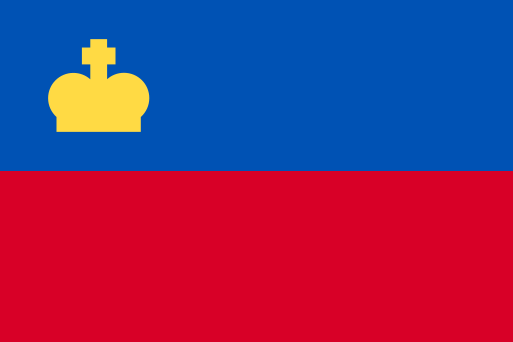
Europe · Western Europe
LI · LIE
- Capital
- Vaduz
- Population
- 40,900
- Area
- 160 km²
- Democracy index
- 74
- Regime type
- Fragmented Democracy
Fuerstentum Liechtenstein
Europe · Western Europe
LI · LIE
Events
The latest elections, referendums, and opinion polls from Liechtenstein. Community totals are not official results.
No public ballots yet
Check back later or explore the global feed.
Classification
The score and regime label are assigned by Porto Voto using our in-house democracy index and classification framework, not ratings from governments or external agencies.
Democracy index
74/100
Regime type
Fragmented Democracy
Liechtenstein operates as a constitutional monarchy paired with a highly robust parliamentary system, offering exceptionally strong protections for civil liberties, safety, and individual rights. The political framework features active citizen participation via direct democracy, as observed during the parliamentary elections and subsequent government formation, which maintained high voter turnout and open competition. However, institutional power distribution remains unique and highly asymmetrical compared to typical European democracies, anchoring the nation in a fragmented classification due to structural governance friction between popular sovereignty and royal authority. The hereditary prince holds expansive constitutional powers, including the right to veto legislation passed by parliament, dissolve the legislature, and block or discontinue judicial prosecutions. A report by the Group of States against Corruption highlighted that this princely authority to quash legal cases limits full accountability, keeping the systemic checks and balances under institutional strain despite impeccable rule of law in regular civil administrative life.
Last evaluation:
How we classify regimes →World Factbook
A concise introduction to Liechtenstein, together with notes on how power and law are organized, to put local ballots in context.
The Principality of Liechtenstein was established within the Holy Roman Empire in 1719. Occupied by both French and Russian troops during the Napoleonic Wars, it became a sovereign state in 1806 and joined the German Confederation in 1815. Liechtenstein became fully independent in 1866 when the Confederation dissolved.
Until the end of World War I, it was closely tied to Austria, but the economic devastation caused by that conflict forced Liechtenstein to enter into a customs and monetary union with Switzerland. Since World War II (in which Liechtenstein remained neutral), the country's low taxes have spurred outstanding economic growth. In 2000, shortcomings in banking regulatory oversight resulted in concerns about the use of financial institutions for money laundering.
However, Liechtenstein implemented anti-money laundering legislation and a Mutual Legal Assistance Treaty with the US that went into effect in 2003.