

Country profile
Lebanon
Al Jumhuriyah al Lubnaniyah
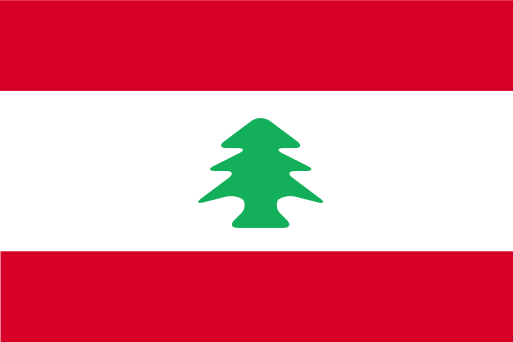
Asia · Western Asia
LB · LBN
- Capital
- Beirut
- Population
- 5,490,000
- Area
- 10,452 km²
- Democracy index
- 4
- Regime type
- Failed State
Al Jumhuriyah al Lubnaniyah
Asia · Western Asia
LB · LBN
Events
The latest elections, referendums, and opinion polls from Lebanon. Community totals are not official results.
No public ballots yet
Check back later or explore the global feed.
Classification
The score and regime label are assigned by Porto Voto using our in-house democracy index and classification framework, not ratings from governments or external agencies.
Democracy index
4/100
Regime type
Failed State
Lebanon is currently experiencing a profound collapse of central authority, as the resumption of major hostilities between Israel and Hezbollah in 2026 has rendered the state incapable of providing basic security or governance. While the January 2025 election of President Joseph Aoun briefly signaled an end to institutional vacuum, the outbreak of the 2026 Lebanon War in March has fundamentally dismantled the state's monopoly on the legitimate use of force. On April 8, 2026, known locally as Black Wednesday, massive Israeli airstrikes on central Beirut and the port of Sidon caused total chaos, with the government powerless to protect its citizens or infrastructure. Approximately 20 percent of the population is currently displaced, and the national territory is effectively partitioned, with Israeli ground forces occupying strategic areas in the south up to the Litani River and Hezbollah operating independently of the Lebanese Armed Forces. Although a fragile 10-day truce was announced on April 16, parliamentary elections originally scheduled for 2026 have been postponed indefinitely to 2028, and the executive's role has been reduced to diplomatic pleading for humanitarian corridors and ceasefire extensions in Washington-hosted talks. The simultaneity of systemic institutional paralysis, the presence of foreign combatants on sovereign soil, and the total inability of the Aoun administration to regulate political or security tempo confirm Lebanon's descent into a failed state.
Last evaluation:
How we classify regimes →World Factbook
A concise introduction to Lebanon, together with notes on how power and law are organized, to put local ballots in context.
As a result of its location at the crossroads of three continents, the area that is modern-day Lebanon is rich in cultural and religious diversity. This region was subject to various foreign conquerors for much of its history, including the Romans, Arabs, and Ottomans. Following World War I, France acquired a mandate over the northern portion of the former Ottoman Empire province of Syria.
From it the French demarcated the region of Lebanon in 1920, and it gained independence in 1943. Lebanon subsequently experienced periods of political turmoil interspersed with prosperity built on its position as a regional center for finance and trade. The country's 1975-90 civil war, which resulted in an estimated 120,000 fatalities, was followed by years of social and political instability, and sectarianism remains a key element of Lebanese political life.
The Israeli defense forces, which occupied parts of Lebanon during the civil war, did not completely withdraw until 2000. Neighboring Syria influenced Lebanon's foreign and domestic policies while its military occupied Lebanon from 1976 until 2005, but its influence diminished significantly after 2005. Over 1.5 million Syrian refugees fled to Lebanon after the start of the Syrian conflict in 2011.
Hizballah -- a major Lebanese political party, militia, and US-designated foreign terrorist organization -- and Israel continued attacks and counterattacks against each other after Syria's withdrawal and fought a brief war in 2006. After HAMAS attacked Israel on 7 October 2023, the intensity and frequency of these cross-border attacks increased substantially into a cycle of hostilities, mostly limited to the border areas as of January 2024. Lebanon's borders with Syria and Israel remain unresolved.
Lebanon's prosperity has significantly diminished since the beginning of the country's economic crisis in 2019, which has crippled its economy, shut down its previously lucrative banking sector, reduced the value of its currency, and caused many Lebanese to emigrate in search of better prospects.