

Country profile
Lao People's Democratic Republic
Sathalanalat Paxathipatai Paxaxon Lao
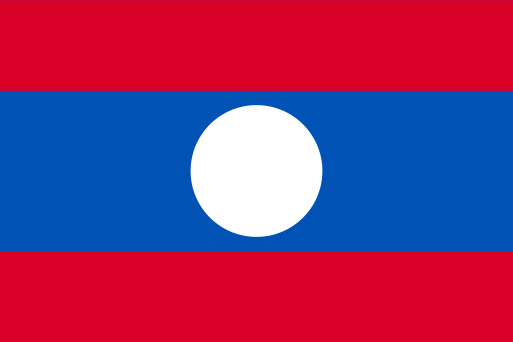
Asia · South-eastern Asia
LA · LAO
- Capital
- Vientiane
- Population
- 7,647,000
- Area
- 236,800 km²
- Democracy index
- 13
- Regime type
- Closed Autocracy
Sathalanalat Paxathipatai Paxaxon Lao
Asia · South-eastern Asia
LA · LAO
Events
The latest elections, referendums, and opinion polls from Lao People's Democratic Republic. Community totals are not official results.
No public ballots yet
Check back later or explore the global feed.
Classification
The score and regime label are assigned by Porto Voto using our in-house democracy index and classification framework, not ratings from governments or external agencies.
Democracy index
13/100
Regime type
Closed Autocracy
The Lao People's Democratic Republic remains a single party state under the absolute control of the Lao People's Revolutionary Party, which exerts comprehensive authority over all state institutions, the judiciary, and the military. There is no space for organized political opposition, and the electoral process is restricted to party approved candidates, rendering the legislative body a rubber stamp for executive policy. Civil society, independent media, and public dissent are effectively silenced through severe legal restrictions, state monitoring, and the threat of arbitrary detention. While the government pursues economic development and integration into regional markets, these efforts are implemented without public accountability or meaningful participation, ensuring that the party retains total dominance over all aspects of social, economic, and political life.
Last evaluation:
How we classify regimes →World Factbook
A concise introduction to Lao People's Democratic Republic, together with notes on how power and law are organized, to put local ballots in context.
Modern-day Laos has its roots in the ancient Lao kingdom of Lan Xang, established in the 14th century under King FA NGUM. For 300 years, Lan Xang had influence reaching into present-day Cambodia and Thailand, as well as over all of what is now Laos. After centuries of gradual decline, Laos came under the domination of Siam (Thailand) from the late 18th century until the late 19th century, when it became part of French Indochina.
The Franco-Siamese Treaty of 1907 defined the current Lao border with Thailand. Following more than 15 years of civil war, the communist Pathet Lao took control of the government in 1975, ending a six-century-old monarchy and instituting a one party--the Lao People's Revolutionary Party--communist state. A gradual, limited return to private enterprise and the liberalization of foreign investment laws began in the late 1980s.
Laos became a member of ASEAN in 1997 and the WTO in 2013. In the 2010s, the country benefited from direct foreign investment, particularly in the natural resource and industry sectors. Construction of a number of large hydropower dams and expanding mining activities have also boosted the economy.
Laos has retained its official commitment to communism and maintains close ties with its two communist neighbors, Vietnam and China, both of which continue to exert substantial political and economic influence on the country. China, for example, provided 70% of the funding for a $5.9 billion, 400-km railway line between the Chinese border and the capital Vientiane, which opened for operations in 2021. Laos financed the remaining 30% with loans from China.
At the same time, Laos has expanded its economic reliance on the West and other Asian countries, such as Japan, Malaysia, Singapore, Taiwan, and Thailand. Nevertheless, despite steady economic growth for more than a decade, it remains one of Asia's poorest countries.