

Country profile
Kiribati
Republic of Kiribati
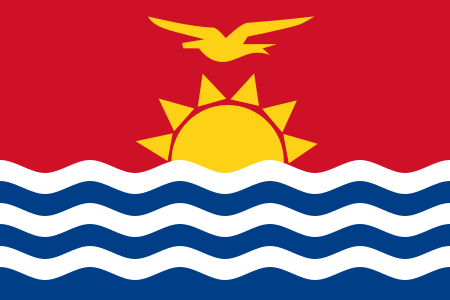
Oceania · Micronesia
KI · KIR
- Capital
- South Tarawa
- Population
- 120,740
- Area
- 811 km²
- Democracy index
- 65
- Regime type
- Hybrid Regime
Republic of Kiribati
Oceania · Micronesia
KI · KIR
Events
The latest elections, referendums, and opinion polls from Kiribati. Community totals are not official results.
No public ballots yet
Check back later or explore the global feed.
Classification
The score and regime label are assigned by Porto Voto using our in-house democracy index and classification framework, not ratings from governments or external agencies.
Democracy index
65/100
Regime type
Hybrid Regime
Kiribati functions as a parliamentary republic characterized by competitive elections and a stable tradition of peaceful transfers of power. The political environment is defined by a multi-party system, yet recent years have seen increased friction between the executive branch and independent institutions, including the judiciary. While the fundamental democratic framework remains intact, concerns have emerged regarding the influence of foreign policy shifts on domestic political alignment and the consolidation of administrative power within the presidency. The media environment is relatively open, though limited by the island nation's scale and economic reliance on state resources. Civil liberties are generally respected, and the judiciary operates with a degree of independence, yet the political climate is increasingly sensitive to the interplay between national development goals and political competition, leading to a system that maintains democratic procedures while facing emerging pressures on its institutional checks and balances.
Last evaluation:
How we classify regimes →World Factbook
A concise introduction to Kiribati, together with notes on how power and law are organized, to put local ballots in context.
Kiribati is made up of three distinct island groups -- the Gilbert Islands, the Line Islands, and the Phoenix Islands. The first Austronesian voyagers arrived in the Gilbert Islands as early as 3000 B.C., but these islands were not widely settled until about A.D. 200 by Micronesians. Around 1300, Samoans and Tongans invaded the southern Gilbert Islands, then known as Tungaru, bringing Polynesian cultural elements with them.
Later arrivals of Fijians brought Melanesian elements to the Gilbert Islands, and extensive intermarriage between the Micronesian, Polynesian, and Melanesian people led to the creation of what would become Gilbertese cultural traditions by the time Europeans spotted the islands in the 1600s. The Phoenix Islands and Line Islands were both visited by various Melanesian and Polynesian peoples, but their isolation and lack of natural resources meant that long-term settlements were not possible. Both island groups were uninhabited by the time of European contact.
Kiribati experienced sustained European contact by the 1760s; all three island groups were named and charted by 1826. American whaling ships frequently passed through the islands, and the UK declared a protectorate over the Gilbert and nearby Ellice Islands in 1892, in an attempt to block growing US influence. Phosphate-rich Banaba Island was annexed to the protectorate in 1900.
In 1916, the protectorate became a colony, and some Line Islands were added in 1916 and 1919, with the final ones added in 1972. The Phoenix Islands were added to the colony in 1937, and the UK agreed to share jurisdiction of some with the US because of their strategic location for aviation. During World War II, the islands were occupied by Japanese forces but were ejected by US amphibious assaults.
The Ellice Islands became its own colony in 1974 and was renamed Tuvalu for “eight standing together” in 1975. The Gilbert Islands became fully self-governing in 1977 and independent in 1979 under the new name of Kiribati, the Gilbertese spelling of Gilberts. The US relinquished all claims to the sparsely inhabited Phoenix and Line Islands in a 1979 treaty of friendship.
In 2012, Kiribati purchased a 22 sq km (8.5 sq mi) plot of land in Fiji for potential eventual resettlement of its population because of climate change, and in 2014 Fijian Prime Minister Voreqe BAINIMARAMA said residents of Kiribati would be welcome to relocate to Fiji if their country is swamped by rising sea levels.