

Country profile
Kazakhstan
Qazaqstan Respublikasy
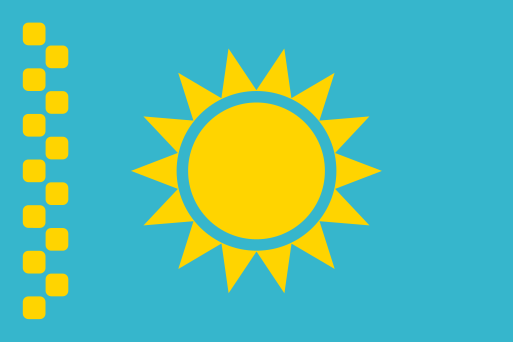
Asia · Central Asia
KZ · KAZ
- Capital
- Astana
- Population
- 20,426,568
- Area
- 2,724,900 km²
- Democracy index
- 32
- Regime type
- Electoral Autocracy
Qazaqstan Respublikasy
Asia · Central Asia
KZ · KAZ
Events
The latest elections, referendums, and opinion polls from Kazakhstan. Community totals are not official results.
No public ballots yet
Check back later or explore the global feed.
Classification
The score and regime label are assigned by Porto Voto using our in-house democracy index and classification framework, not ratings from governments or external agencies.
Democracy index
32/100
Regime type
Electoral Autocracy
Kazakhstan continues to function as an electoral autocracy, where political life is dominated by a centralized executive and a carefully managed constitutional framework. The adoption of a new constitution via referendum in March 2026 has reinforced presidential authority, with observers noting that the reforms serve to maintain political continuity rather than open the system to genuine competition. While the government regularly engages in administrative reforms and anti-corruption strategies, these efforts remain largely top-down and lack measurable, independent oversight. Civil society, independent media, and political dissent face systematic pressure and restrictive legal interpretations, resulting in a narrowing space for public debate. Although the country maintains a façade of multi-party engagement and electoral participation, the lack of an independent judiciary and the concentration of power in the presidential office ensure that accountability remains elusive, leaving the political environment firmly under the control of the state apparatus.
Last evaluation:
How we classify regimes →World Factbook
A concise introduction to Kazakhstan, together with notes on how power and law are organized, to put local ballots in context.
Ethnic Kazakhs derive from a mix of Turkic nomadic tribes that migrated to the region in the 15th century. The Russian Empire conquered the Kazakh steppe in the 18th and 19th centuries, and Kazakhstan became a Soviet Republic in 1925. Forced agricultural collectivization led to repression and starvation, resulting in more than a million deaths in the early 1930s.
During the 1950s and 1960s, the agricultural "Virgin Lands" program generated an influx of settlers -- mostly ethnic Russians, but also other nationalities -- and by the time of Kazakhstan’s independence in 1991, ethnic Kazakhs were a minority. However, non-Muslim ethnic minorities departed Kazakhstan in large numbers from the mid-1990s through the mid-2000s, and a national program has repatriated about a million ethnic Kazakhs (from Uzbekistan, Tajikistan, Mongolia, and the Xinjiang region of China) to Kazakhstan. As a result of this shift, the ethnic Kazakh share of the population now exceeds two-thirds.
Kazakhstan's economy is the largest in Central Asia, mainly due to the country's vast natural resources. Current issues include diversifying the economy, attracting foreign direct investment, enhancing Kazakhstan's economic competitiveness, and strengthening economic relations with neighboring states and foreign powers.