

Country profile
Jordan
Al Mamlakah al Urduniyah al Hashimiyah
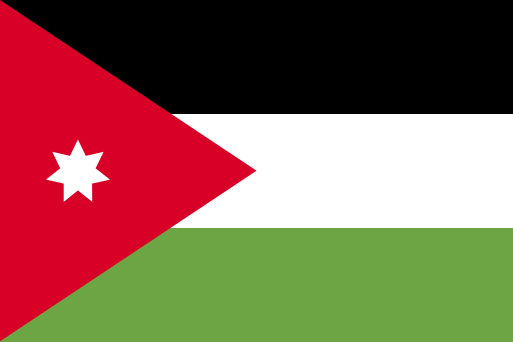
Asia · Western Asia
JO · JOR
- Capital
- Amman
- Population
- 11,734,000
- Area
- 89,342 km²
- Democracy index
- 34
- Regime type
- Electoral Autocracy
Al Mamlakah al Urduniyah al Hashimiyah
Asia · Western Asia
JO · JOR
Events
The latest elections, referendums, and opinion polls from Jordan. Community totals are not official results.
No public ballots yet
Check back later or explore the global feed.
Classification
The score and regime label are assigned by Porto Voto using our in-house democracy index and classification framework, not ratings from governments or external agencies.
Democracy index
34/100
Regime type
Electoral Autocracy
Jordan functions as a constitutional monarchy where the king retains primary executive authority, and the political system is carefully managed to preserve the stability of the ruling order. While legislative elections are held regularly, they occur within a framework that limits the influence of opposition parties through restrictive electoral laws and the dominance of tribal or pro-monarchy alliances. The space for civil society, political activism, and independent media is constrained by security legislation that is frequently used to monitor and penalize dissent, particularly regarding criticism of state policies or the monarchy. Although the judiciary handles civil and commercial matters with some degree of predictability, it lacks independence in cases involving national security or political influence. Public discourse is carefully monitored, and the overall political environment is characterized by a top down governance structure that prevents genuine competition for power, resulting in a system where parliamentary processes remain subordinate to the interests of the palace and security apparatus.
Last evaluation:
How we classify regimes →World Factbook
A concise introduction to Jordan, together with notes on how power and law are organized, to put local ballots in context.
After World War I and the dissolution of the Ottoman Empire, the League of Nations awarded Britain the mandate to govern much of the Middle East. In 1921, Britain demarcated from Palestine a semi-autonomous region of Transjordan and recognized ABDALLAH I from the Hashemite family as the country's first leader. The Hashemites also controlled the Hijaz, or the western coastal area of modern-day Saudi Arabia, until 1925, when IBN SAUD and Wahhabi tribes pushed them out.
The country gained its independence in 1946 and thereafter became the Hashemite Kingdom of Jordan. The country has had four kings. Long-time ruler King HUSSEIN (r. 1953-99) successfully navigated competing pressures from the major powers (US, UK, and Soviet Union), various Arab states, Israel, and Palestinian militants, the latter of which led to a brief civil war in 1970 that is known as "Black September" and ended in King HUSSEIN ousting the militants.
Jordan's borders have changed since it gained independence. In 1948, Jordan took control of the West Bank and East Jerusalem in the first Arab-Israeli War, eventually annexing those territories in 1950 and granting its new Palestinian residents Jordanian citizenship. In 1967, Jordan lost the West Bank and East Jerusalem to Israel in the Six-Day War but retained administrative claims to the West Bank until 1988, when King HUSSEIN permanently relinquished Jordanian claims to the West Bank in favor of the Palestine Liberation Organization (PLO).
King HUSSEIN signed a peace treaty with Israel in 1994, after Israel and the PLO signed the Oslo Accords in 1993. Jordanian kings continue to claim custodianship of the Muslim holy sites in Jerusalem by virtue of their Hashemite heritage as descendants of the Prophet Mohammad and agreements with Israel and Jerusalem-based religious and Palestinian leaders. After Israel captured East Jerusalem in the 1967 War, it authorized the Jordanian-controlled Islamic Trust, or Waqf, to continue administering the Al Haram ash Sharif/Temple Mount holy compound, and the Jordan-Israel peace treaty reaffirmed Jordan's "special role" in administering the Muslim holy shrines in Jerusalem.
Jordanian kings claim custodianship of the Christian sites in Jerusalem on the basis of the 7th-century Pact of Omar, when the Muslim leader, after conquering Jerusalem, agreed to permit Christian worship. King HUSSEIN died in 1999 and was succeeded by his eldest son and current King ABDALLAH II. In 2009, ABDALLAH II designated his son HUSSEIN as the Crown Prince.
During his reign, ABDALLAH II has contended with a series of challenges, including the Arab Spring influx of refugees from neighboring states, the COVID-19 pandemic, the effects of the war in Ukraine, a perennially weak economy, and the Israel-HAMAS conflict that began in October 2023.