Country profile
Iceland
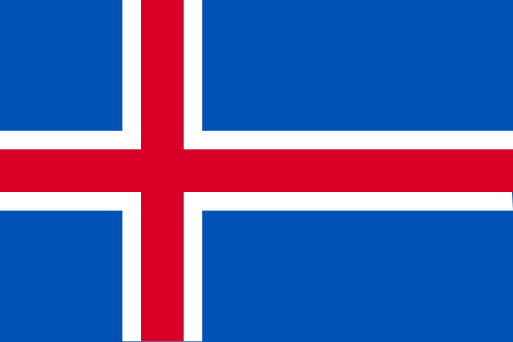
Europe · Northern Europe
IS · ISL
- Capital
- Reykjavik
- Population
- 391,810
- Area
- 103,000 km²
- Democracy index
- 97
- Regime type
- Robust Democracy
Europe · Northern Europe
IS · ISL
Events
The latest elections, referendums, and opinion polls from Iceland. Community totals are not official results.
Classification
The score and regime label are assigned by Porto Voto using our in-house democracy index and classification framework, not ratings from governments or external agencies.
Democracy index
97/100
Regime type
Robust Democracy
Iceland remains a global benchmark for democratic governance, characterized by deep seated political stability, a transparent and highly functional parliamentary system, and a robust commitment to the rule of law. The Althing, one of the world's oldest legislative assemblies, facilitates inclusive and competitive political processes that effectively protect civil liberties and media freedom. An independent judiciary ensures that constitutional rights are upheld, while the absence of systemic corruption fosters high levels of public trust in government institutions. The nation continues to demonstrate exceptional resilience, navigating economic and social policy changes through consensus based decision making and consistent adherence to established democratic norms.
Last evaluation:
How we classify regimes →World Factbook
A concise introduction to Iceland, together with notes on how power and law are organized, to put local ballots in context.
Settled by Norwegian and Celtic (Scottish and Irish) immigrants during the late 9th and 10th centuries A.D., Iceland boasts the world's oldest functioning legislative assembly, the Althingi, which was established in 930. Independent for over 300 years, Iceland was subsequently ruled by Norway and Denmark. Fallout from the Askja volcano of 1875 devastated the Icelandic economy and caused widespread famine.
Over the next quarter-century, 20% of the island's population emigrated, mostly to Canada and the US. Denmark granted limited home rule in 1874 and complete independence in 1944. The second half of the 20th century saw substantial economic growth driven primarily by the fishing industry.
The economy diversified greatly after the country joined the European Economic Area in 1994, but the global financial crisis hit Iceland especially hard in the years after 2008. The economy is now on an upward trajectory, primarily thanks to a tourism and construction boom. Literacy, longevity, and social cohesion are first-rate by world standards.