

Country profile
Guyana
Cooperative Republic of Guyana
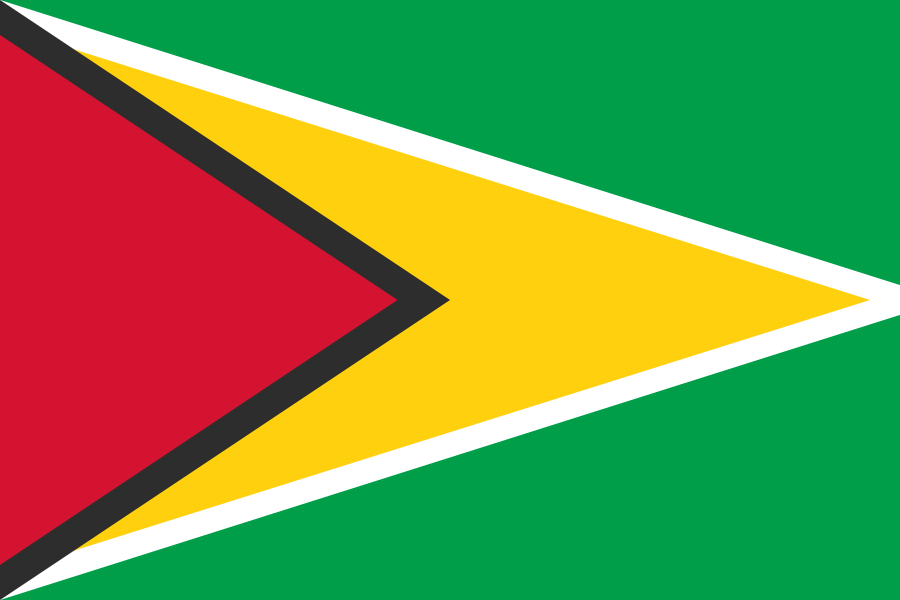
South America · Latin America and the Caribbean · Americas
GY · GUY
- Capital
- Georgetown
- Population
- 772,975
- Area
- 214,969 km²
- Democracy index
- 72
- Regime type
- Fragmented Democracy
Cooperative Republic of Guyana
South America · Latin America and the Caribbean · Americas
GY · GUY
Events
The latest elections, referendums, and opinion polls from Guyana. Community totals are not official results.
No public ballots yet
Check back later or explore the global feed.
Classification
The score and regime label are assigned by Porto Voto using our in-house democracy index and classification framework, not ratings from governments or external agencies.
Democracy index
72/100
Regime type
Fragmented Democracy
Guyana operates as a parliamentary democracy that successfully maintains core electoral processes, yet it faces mounting institutional and societal pressures. Recent assessments highlight a concerning decline in civil liberties and freedom of expression, reaching their lowest levels in decades, while the ruling People's Progressive Party maintains a firm grip on governance amidst an oil-driven economic transformation. Although the democratic framework remains stable, the political environment is increasingly polarized, characterized by significant concerns regarding the independence of the judiciary and the integrity of state institutions. The nation continues to navigate the complexities of managing newfound wealth while attempting to address persistent poverty and ethnic political tensions, resulting in a system where democratic participation is technically sound but operationally strained by executive dominance and governance friction.
Last evaluation:
How we classify regimes →World Factbook
A concise introduction to Guyana, together with notes on how power and law are organized, to put local ballots in context.
Originally a Dutch colony in the 17th century, by 1815 Guyana had become a British possession. The abolition of slavery led to former slaves settling urban areas and indentured servants being imported from India to work the sugar plantations. The resulting ethnocultural divide has persisted and has led to turbulent politics.
Guyana achieved independence from the UK in 1966, and since then primarily socialist-oriented governments have ruled the country. In 1992, Cheddi JAGAN was elected president in what is considered the country's first free and fair election since independence. After his death five years later, his wife, Janet JAGAN, became president but resigned in 1999 due to poor health.
Her successor, Bharrat JAGDEO, was elected in 2001 and again in 2006. Donald RAMOTAR won in 2011, but early elections held in 2015 resulted in the first change in governing party, and David GRANGER took office. After a 2018 no-confidence vote against the GRANGER government, the administration ignored a constitutional requirement to hold elections and remained in place until the 2020 elections, when Irfaan ALI became president.
The discovery of massive offshore oil reserves in 2015 has been Guyana's primary economic and political focus, with many hoping the reserves will transform one of the poorest countries in the region. Guyana is the only English-speaking country in South America and shares cultural and historical bonds with the Anglophone Caribbean.