

Country profile
Guinea-Bissau
Republica da Guine-Bissau
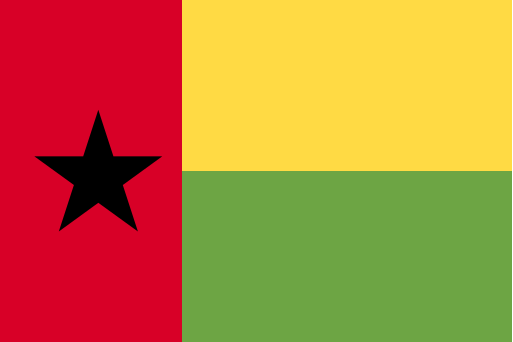
Africa · Sub-Saharan Africa
GW · GNB
- Capital
- Bissau
- Population
- 1,781,308
- Area
- 36,125 km²
- Democracy index
- 32
- Regime type
- Electoral Autocracy
Republica da Guine-Bissau
Africa · Sub-Saharan Africa
GW · GNB
Events
The latest elections, referendums, and opinion polls from Guinea-Bissau. Community totals are not official results.
No public ballots yet
Check back later or explore the global feed.
Classification
The score and regime label are assigned by Porto Voto using our in-house democracy index and classification framework, not ratings from governments or external agencies.
Democracy index
32/100
Regime type
Electoral Autocracy
Guinea Bissau remains politically fragile following the military coup in late November 2025 that ousted President Umaro Sissoco Embalo and suspended the electoral process. A transitional military junta under the High Military Command holds executive authority, and while tentative arrangements point toward elections in late 2026, widespread restrictions on civil liberties, the dissolution of parliament, and the suppression of key opposition figures persist. Systemic vulnerabilities including entrenched corruption and constrained civic spaces continue to undermine the rule of law and democratic recovery.
Last evaluation:
How we classify regimes →World Factbook
A concise introduction to Guinea-Bissau, together with notes on how power and law are organized, to put local ballots in context.
For much of its history, Guinea-Bissau was under the control of the Mali Empire and the Kaabu Kingdom. In the 16th century, Portugal began establishing trading posts along Guinea-Bissau’s shoreline. Initially, the Portuguese were restricted to the coastline and islands.
However, the slave and gold trades were lucrative to local African leaders, and the Portuguese were slowly able to expand their power and influence inland. Starting in the 18th century, the Mali Empire and Kingdom of Kaabu slowly disintegrated into smaller local entities. By the 19th century, Portugal had fully incorporated Guinea-Bissau into its empire.
Since gaining independence in 1974, Guinea-Bissau has experienced considerable political and military upheaval. In 1980, a military coup established General Joao Bernardo 'Nino' VIEIRA as president. VIEIRA's regime suppressed political opposition and purged political rivals.
Several coup attempts through the 1980s and early 1990s failed to unseat him, but a military mutiny and civil war in 1999 led to VIEIRA's ouster. In 2000, a transitional government turned over power to opposition leader Kumba YALA. In 2003, a bloodless military coup overthrew YALA and installed businessman Henrique ROSA as interim president.
In 2005, VIEIRA was reelected, pledging to pursue economic development and national reconciliation; he was assassinated in 2009. Malam Bacai SANHA was then elected president, but he passed away in 2012 from a long-term illness. A military coup blocked the second round of the election to replace him, but after mediation from the Economic Community of Western African States, a civilian transitional government assumed power.
In 2014, Jose Mario VAZ was elected president in a free and fair election, and in 2019, he became the first president in Guinea-Bissau’s history to complete a full term. Umaro Sissoco EMBALO was elected president in 2019, but he did not take office until 2020 because of a prolonged challenge to the election results.