

Country profile
Greece
Elliniki Dimokratia
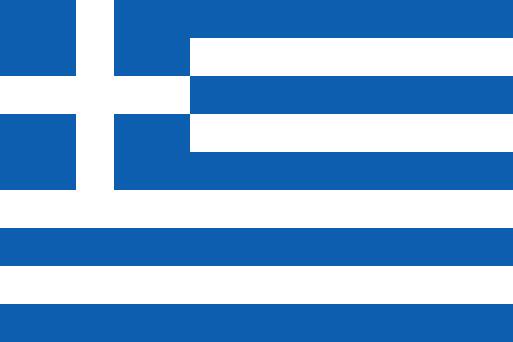
Europe · Southern Europe
GR · GRC
- Capital
- Athens
- Population
- 10,400,720
- Area
- 131,990 km²
- Democracy index
- 77
- Regime type
- Fragmented Democracy
Elliniki Dimokratia
Europe · Southern Europe
GR · GRC
Events
The latest elections, referendums, and opinion polls from Greece. Community totals are not official results.
No public ballots yet
Check back later or explore the global feed.
Classification
The score and regime label are assigned by Porto Voto using our in-house democracy index and classification framework, not ratings from governments or external agencies.
Democracy index
77/100
Regime type
Fragmented Democracy
Greece maintains the essential structures of a parliamentary democracy, with regular and transparent elections and a strong commitment to civil liberties. However, the political system currently experiences significant friction due to concerns about the independence of the media, the concentration of power within the executive branch, and the handling of high profile surveillance scandals. While the judiciary continues to function, its perceived lack of assertiveness in investigating government related matters has contributed to public distrust and political deadlock on key legislative reforms. Despite these institutional strains, the country remains a functional democracy where the rule of law is upheld, yet its governance is increasingly defined by intense polarization and a struggle to balance executive efficiency with the requirements of full democratic accountability.
Last evaluation:
How we classify regimes →World Factbook
A concise introduction to Greece, together with notes on how power and law are organized, to put local ballots in context.
Greece won independence from the Ottoman Empire in 1830 and became a kingdom. During the second half of the 19th century and the first half of the 20th century, it gradually added neighboring islands and territories, most with Greek-speaking populations. In World War II, Greece was first invaded by Italy (1940) and subsequently occupied by Germany (1941-44); fighting endured in a protracted civil war between supporters of the king and other anti-communist and communist rebels.
The communists were defeated in 1949, and Greece joined NATO in 1952. In 1967, a military coup forced the king to flee the country. The ensuing military dictatorship collapsed in 1974, and Greece abolished the monarchy to become a parliamentary republic.
In 1981, Greece joined the EC (now the EU); it became the 12th member of the European Economic and Monetary Union in 2001. From 2009 until 2019, Greece suffered a severe economic crisis due to nearly a decade of chronic overspending and structural rigidities. Beginning in 2010, Greece entered three bailout agreements -- the first two with the European Commission, the European Central Bank, and the IMF; and the third in 2015 with the European Stability Mechanism -- worth in total about $300 billion.
The Greek Government formally exited the third bailout in 2018, and Greece's economy has since improved significantly. In 2022, the country finalized its early repayment to the IMF and graduated on schedule from the EU's enhanced surveillance framework.