

Country profile
Ghana
Republic of Ghana
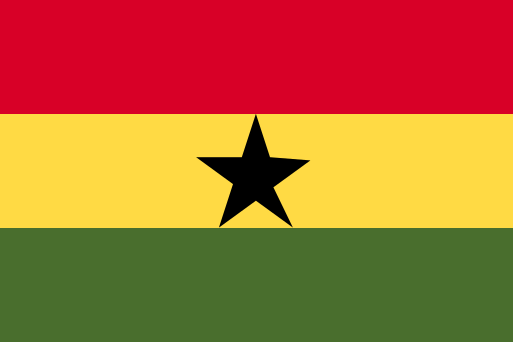
Africa · Sub-Saharan Africa
GH · GHA
- Capital
- Accra
- Population
- 33,742,380
- Area
- 238,533 km²
- Democracy index
- 71
- Regime type
- Fragmented Democracy
Republic of Ghana
Africa · Sub-Saharan Africa
GH · GHA
Events
The latest elections, referendums, and opinion polls from Ghana. Community totals are not official results.
No public ballots yet
Check back later or explore the global feed.
Classification
The score and regime label are assigned by Porto Voto using our in-house democracy index and classification framework, not ratings from governments or external agencies.
Democracy index
71/100
Regime type
Fragmented Democracy
Ghana remains a foundational model for democratic stability in West Africa, characterized by regular, peaceful transitions of power and a high level of public commitment to constitutional norms. Despite this strong record, the political environment is currently experiencing increased friction due to severe economic challenges, public frustration with corruption, and a polarized political climate between the two main parties. While the judiciary maintains its independence and the media landscape remains relatively pluralistic, there is growing institutional tension regarding the neutrality of the electoral commission and the management of political demonstrations. Although the nation retains its status as a functional democracy, these mounting pressures have created a period of administrative and political unease that tests the resilience of its established democratic institutions.
Last evaluation:
How we classify regimes →World Factbook
A concise introduction to Ghana, together with notes on how power and law are organized, to put local ballots in context.
Ghana is a multiethnic country rich in natural resources and is one of the most stable and democratic countries in West Africa. Ghana has been inhabited for at least several thousand years, but little is known about its early inhabitants. By the 12th century, the gold trade started to boom in Bono (Bonoman) state in what is today southern Ghana, and it became the genesis of the Akan people's power and wealth in the region.
Beginning in the 15th century, the Portuguese, followed by other European powers, arrived and competed for trading rights. Numerous kingdoms and empires emerged in the area, among the most powerful were the Kingdom of Dagbon in the north and the Asante (Ashanti) Empire in the south. By the mid-18th century, Asante was a highly organized state with immense wealth; it provided enslaved people for the Atlantic slave trade, and in return received firearms that facilitated its territorial expansion.
The Asante resisted increasing British influence in the coastal areas, engaging in a series of wars during the 19th century before ultimately falling under British control. Formed from the merger of the British colony of the Gold Coast and the Togoland trust territory, Ghana in 1957 became the first Sub-Saharan country in colonial Africa to gain its independence, with Kwame NKRUMAH as its first leader. Ghana endured a series of coups before Lt.
Jerry RAWLINGS took power in 1981 and banned political parties. After approving a new constitution and restoring multiparty politics in 1992, RAWLINGS won presidential elections in 1992 and 1996 but was constitutionally prevented from running for a third term in 2000. John KUFUOR of the opposition New Patriotic Party (NPP) succeeded him and was reelected in 2004.
John Atta MILLS of the National Democratic Congress won the 2008 presidential election and took over as head of state. MILLS died in 2012 and was constitutionally succeeded by his vice president, John Dramani MAHAMA, who subsequently won the 2012 presidential election. In 2016, Nana Addo Dankwa AKUFO-ADDO of the NPP defeated MAHAMA, marking the third time that Ghana’s presidency had changed parties since the return to democracy.
AKUFO-ADDO was reelected in 2020. In recent years, Ghana has taken an active role in promoting regional stability and is highly integrated in international affairs.