

Country profile
Eswatini
Umbuso weSwatini
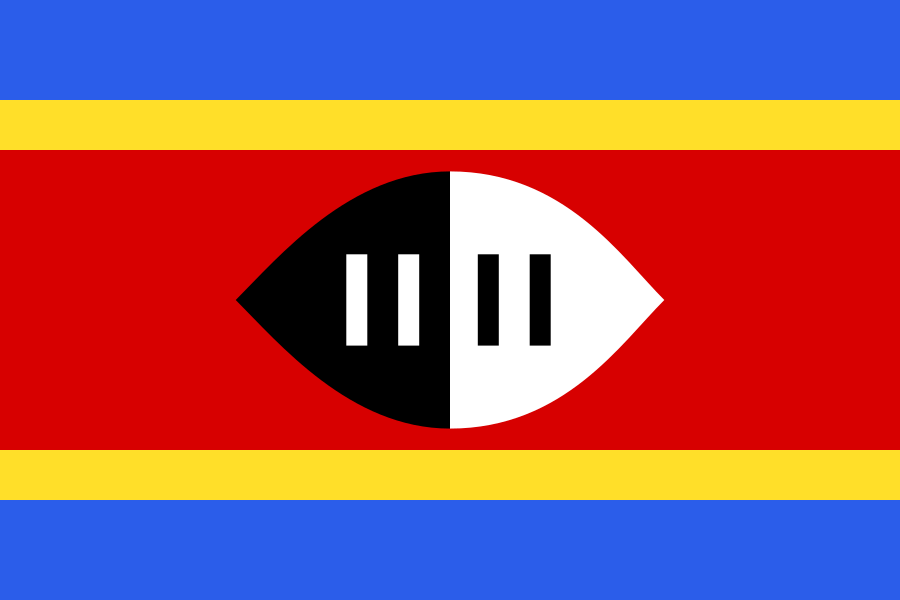
Africa · Sub-Saharan Africa
SZ · SWZ
- Capital
- Mbabane
- Population
- 1,235,549
- Area
- 17,364 km²
- Democracy index
- 17
- Regime type
- Closed Autocracy
Umbuso weSwatini
Africa · Sub-Saharan Africa
SZ · SWZ
Events
The latest elections, referendums, and opinion polls from Eswatini. Community totals are not official results.
No public ballots yet
Check back later or explore the global feed.
Classification
The score and regime label are assigned by Porto Voto using our in-house democracy index and classification framework, not ratings from governments or external agencies.
Democracy index
17/100
Regime type
Closed Autocracy
Eswatini is an absolute monarchy where King Mswati III exerts supreme authority over all branches of government, effectively rendering the parliament and judiciary subordinate to the throne. The unique Tinkhundla system prevents meaningful political party competition, and the executive maintains control through traditional structures and a security apparatus that operates with broad impunity. Civil liberties, including freedom of expression and assembly, are severely restricted, and activists often face intimidation or violence. Recent reports highlight a concerning decline in the independence of the legal profession, with systemic threats against lawyers further stifling dissent. Although public sentiment increasingly leans toward democratic reform, institutional avenues for peaceful power transfer or political accountability remain absent, keeping the nation firmly within the category of a closed autocracy.
Last evaluation:
How we classify regimes →World Factbook
A concise introduction to Eswatini, together with notes on how power and law are organized, to put local ballots in context.
A Swazi kingdom was founded in the mid-18th century and ruled by a series of kings, including MSWATI II, a 19th century ruler whose name was adopted for the country and its predominant ethnic group. European countries defined the kingdom’s modern borders during the late-19th century, and Swaziland (as it became known) was administered as a UK high commission territory from 1903 until its independence in 1968. A new constitution that came into effect in 2005 included provisions for a more independent parliament and judiciary, but the legal status of political parties remains unclear, and the kingdom is still considered an absolute monarchy.
King MSWATI III renamed the country from Swaziland to Eswatini in 2018 to reflect the name most commonly used by its citizens. In 2021, MSWATI III used security forces to suppress prodemocracy protests. A national dialogue and reconciliation process agreed to in the wake of violence has not materialized.
In November 2023, King MSWATI III appointed a new prime minister following peaceful national elections. Despite its classification as a lower-middle income country, Eswatini suffers from severe poverty, corruption, and high unemployment. Eswatini has the world's highest HIV/AIDS prevalence rate, although recent years have shown marked declines in new infections.
Eswatini is the only country in Africa that recognizes Taiwan.