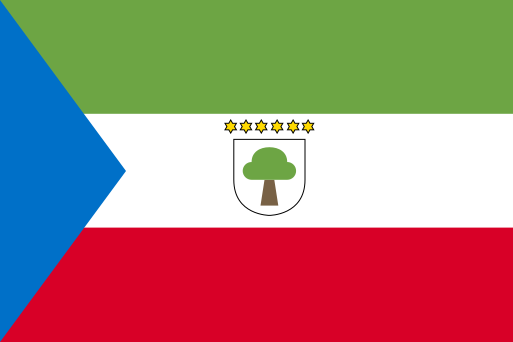
Equatorial Guinea
Republica de Guinea Ecuatorial (Spanish)/ République de Guinée équatoriale (French)
Africa · Sub-Saharan Africa
GQ · GNQ
- Capital
- Ciudad de la Paz
- Population
- 1,668,768
- Area
- 28,051 km²
- Democracy index
- 6
- Regime type
- Closed Autocracy
Republica de Guinea Ecuatorial (Spanish)/ République de Guinée équatoriale (French)
Africa · Sub-Saharan Africa
GQ · GNQ
Events
The latest elections, referendums, and opinion polls from Equatorial Guinea. Community totals are not official results.
No public ballots yet
Check back later or explore the global feed.
Classification
The score and regime label are assigned by Porto Voto using our in-house democracy index and classification framework, not ratings from governments or external agencies.
Democracy index
6/100
Regime type
Closed Autocracy
Equatorial Guinea remains one of the most closed and repressive societies in the world, dominated by President Teodoro Obiang Nguema Mbasogo, the world's longest serving non-royal head of state. As of May 2026, the administration continues to exercise absolute control over all state institutions, including a legislature and judiciary that function as mere extensions of the executive branch. The political environment is characterized by the systematic suppression of any organized opposition, with frequent reports of arbitrary arrests, torture, and the forced disappearance of activists. Freedom of expression and assembly are non-existent; the state maintains a total monopoly on domestic media and tightly monitors digital communications to stifle dissent. Recent international focus has shifted toward the government's role in third-party deportation agreements with the United States, yet these strategic maneuvers have not led to any domestic loosening of political control. Corruption remains pervasive and deeply structural, with the nation's significant oil wealth concentrated among a tiny elite closely tied to the Obiang family, while the majority of the population lacks access to basic services. There are no credible avenues for peaceful political transition, and the state's security apparatus remains the primary tool for maintaining a regime defined by total executive dominance and the complete absence of civil liberties.
Last evaluation:
How we classify regimes →World Factbook
A concise introduction to Equatorial Guinea, together with notes on how power and law are organized, to put local ballots in context.
Equatorial Guinea consists of a continental territory and five inhabited islands; it is one of the smallest countries by area and population in Africa. The mainland region was most likely predominantly inhabited by Pygmy ethnic groups prior to the migration of various Bantu-speaking ethnic groups around the second millennium BC. The island of Bioko, the largest of Equatorial Guinea’s five inhabited islands and the location of the country’s capital of Malabo, has been occupied since at least 1000 B.C.
In the early 1470s, Portuguese explorers landed on Bioko Island, and Portugal soon after established control of the island and other areas of modern Equatorial Guinea. In 1778, Portugal ceded its colonial hold over present-day Equatorial Guinea to Spain in the Treaty of El Pardo. The borders of modern-day Equatorial Guinea would evolve between 1778 and 1968 as the area remained under European colonial rule.
In 1968, Equatorial Guinea was granted independence from Spain and elected Francisco MACIAS NGUEMA as its first president. MACIAS consolidated power soon after his election and ruled brutally for over a decade. Under his regime, Equatorial Guinea experienced mass suppression, purges, and killings.
Some estimates indicate that a third of the population either went into exile or was killed under MACIAS’ rule. In 1979, present-day President OBIANG Nguema Mbasogo, then a senior military officer, deposed MACIAS in a violent coup. OBIANG has ruled since and has been elected in non-competitive contests several times, most recently in 2022.
The president exerts near-total control over the political system. Equatorial Guinea experienced rapid economic growth in the early years of the 21st century due to the discovery of large offshore oil reserves in 1996. Production peaked in 2004 and has declined since.
The country's economic windfall from oil production resulted in massive increases in government revenue, a significant portion of which was earmarked for infrastructure development. Systemic corruption, however, has hindered socio-economic development, and the population has seen only limited improvements to living standards. Equatorial Guinea continues to seek to diversify its economy, increase foreign investment, and assume a greater role in regional and international affairs.