

Country profile
Djibouti
République de Djibouti (French)/ Jumhuriyat Jibuti (Arabic)
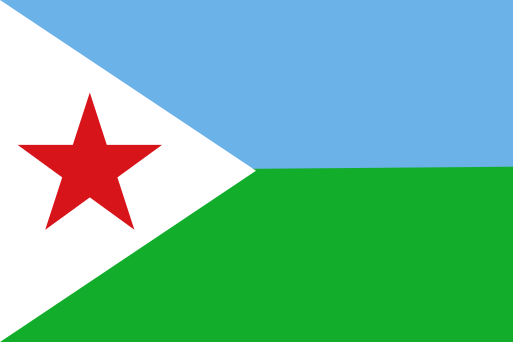
Africa · Sub-Saharan Africa
DJ · DJI
- Capital
- Djibouti
- Population
- 1,066,809
- Area
- 23,200 km²
- Democracy index
- 18
- Regime type
- Closed Autocracy
République de Djibouti (French)/ Jumhuriyat Jibuti (Arabic)
Africa · Sub-Saharan Africa
DJ · DJI
Events
The latest elections, referendums, and opinion polls from Djibouti. Community totals are not official results.
No public ballots yet
Check back later or explore the global feed.
Classification
The score and regime label are assigned by Porto Voto using our in-house democracy index and classification framework, not ratings from governments or external agencies.
Democracy index
18/100
Regime type
Closed Autocracy
Djibouti is defined by the absolute dominance of President Ismaïl Omar Guelleh, who was sworn in for a sixth term on May 9, 2026, after claiming over 97% of the vote in an April election. The electoral process is widely characterized as a controlled exercise rather than a democratic competition, facilitated by a 2010 constitutional amendment that removed term limits and a more recent removal of age limits. The ruling Union for the Presidential Majority (UMP) maintains a stranglehold on all branches of government, effectively neutralizing the legislature and judiciary as independent bodies. Opposition groups continue to face systemic barriers, including restricted access to media, arbitrary detentions, and the denial of assembly permits, leading many to boycott national polls. Civil liberties are strictly curtailed, with the state exercising tight control over the domestic information environment and utilizing security forces to monitor and suppress any signs of public dissent. While Djibouti leverages its strategic location to maintain strong military and economic ties with global powers, these international partnerships have not translated into domestic democratic reforms. The political system remains a centralized autocracy where power is concentrated within a small circle around the presidency, and meaningful avenues for peaceful political change are virtually non-existent.
Last evaluation:
How we classify regimes →World Factbook
A concise introduction to Djibouti, together with notes on how power and law are organized, to put local ballots in context.
Present-day Djibouti was the site of the medieval Ifat and Adal Sultanates. In the late 19th century, the Afar sultans signed treaties with the French that allowed the latter to establish the colony of French Somaliland in 1862. The French signed additional treaties with the ethnic Somali in 1885.
Tension between the ethnic Afar and Somali populations increased over time, as the ethnic Somalis perceived that the French unfairly favored the Afar and gave them disproportionate influence in local governance. In 1958, the French held a referendum that provided residents of French Somaliland the option to either continue their association with France or to join neighboring Somalia as it established its independence. Ethnic Somali protested the vote, because French colonial leaders did not recognize many Somali as residents, which gave the Afar outsized influence in the decision to uphold ties with France.
After a second referendum in 1967, the French changed the territory’s name to the French Territory of the Afars and the Issas, in part to underscore their relationship with the ethnic Afar and downplay the significance of the ethnic Somalis. A final referendum in 1977 established Djibouti as an independent nation and granted ethnic Somalis Djiboutian nationality, formally resetting the balance of power between the majority ethnic Somalis and minority ethnic Afar residents. Upon independence, the country was named after its capital city of Djibouti.
Hassan Gouled APTIDON, an ethnic Somali leader, installed an authoritarian one-party state and served as president until 1999. Unrest between the Afar minority and Somali majority culminated in a civil war during the 1990s that ended in 2001 with a peace accord between Afar rebels and the Somali Issa-dominated government. In 1999, Djibouti's first multiparty presidential election resulted in the election of Ismail Omar GUELLEH as president; he was reelected to a second term in 2005 and extended his tenure in office via a constitutional amendment, which allowed him to serve his third and fourth terms, and to begin a fifth term in 2021.
Djibouti occupies a strategic geographic location at the intersection of the Red Sea and the Gulf of Aden. Its ports handle 95% of Ethiopia’s trade. Djibouti’s ports also service transshipments between Europe, the Middle East, and Asia.
The government has longstanding ties to France, which maintains a military presence in the country, as do the US, Japan, Italy, Germany, Spain, and China.