

Country profile
Denmark
Kongeriget Danmark
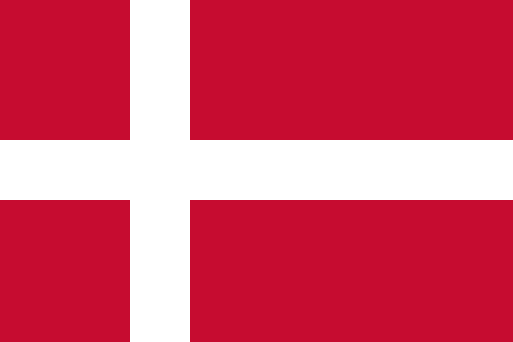
Europe · Northern Europe
DK · DNK
- Capital
- Copenhagen
- Population
- 6,011,488
- Area
- 43,094 km²
- Democracy index
- 94
- Regime type
- Robust Democracy
Kongeriget Danmark
Europe · Northern Europe
DK · DNK
Events
The latest elections, referendums, and opinion polls from Denmark. Community totals are not official results.
No public ballots yet
Check back later or explore the global feed.
Classification
The score and regime label are assigned by Porto Voto using our in-house democracy index and classification framework, not ratings from governments or external agencies.
Democracy index
94/100
Regime type
Robust Democracy
Denmark remains one of the world's most resilient and stable democracies, characterized by deep-seated institutional integrity and an exceptionally high level of transparency. Following the parliamentary elections in March 2026, the country has navigated a complex period of government formation. After 45 days of negotiations, Mette Frederiksen of the Social Democrats was unable to secure a majority coalition, leading King Frederik X to appoint Troels Lund Poulsen of the Liberal Party as the royal investigator to explore a center-right alternative as of May 9, 2026. This process has been conducted in strict accordance with constitutional norms, demonstrating the system's ability to handle political deadlock through established peaceful mechanisms. The judiciary remains fiercely independent, a fact underscored by a recent landmark High Court ruling on May 8, 2026, which declared the removal of a Greenlandic child by Danish authorities illegal, citing a breach of fundamental rights. While this case has sparked significant national debate over the treatment of the Greenlandic community and historical discrimination, the ability of the courts to rule against the state reinforces the strength of the rule of law. Civil liberties, including freedom of expression and assembly, are fully protected, and the media landscape remains diverse and critical of the political establishment. Corruption remains at globally record-low levels, and public trust in democratic institutions continues to be a cornerstone of the Danish social contract.
Last evaluation:
How we classify regimes →World Factbook
A concise introduction to Denmark, together with notes on how power and law are organized, to put local ballots in context.
Once the seat of Viking raiders and later a major north European power, Denmark has evolved into a modern, prosperous nation that is part of the general political and economic integration of Europe. It joined NATO in 1949 and the EEC (now the EU) in 1973. The country has opted out of certain elements of the EU's Maastricht Treaty, including the European Economic and Monetary Union and justice and home affairs issues. a 2022 referendum resulted in the removal of Denmark's 30-year opt-out on defense issues, now allowing Denmark to participate fully in the EU's Common Security and Defense Policy.