

Country profile
Cyprus
Kypriaki Dimokratia (Greek)/ Kibris Cumhuriyeti (Turkish)
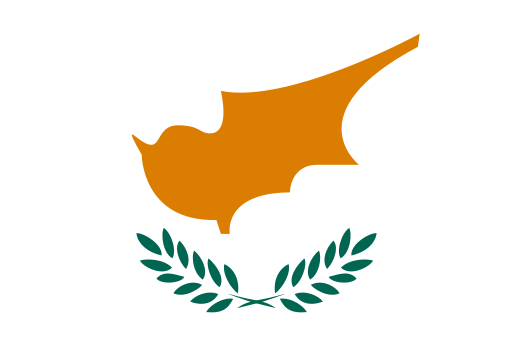
Asia · Western Asia
CY · CYP
- Capital
- Nicosia
- Population
- 1,442,614
- Area
- 9,251 km²
- Democracy index
- 86
- Regime type
- Robust Democracy
Kypriaki Dimokratia (Greek)/ Kibris Cumhuriyeti (Turkish)
Asia · Western Asia
CY · CYP
Events
The latest elections, referendums, and opinion polls from Cyprus. Community totals are not official results.
No public ballots yet
Check back later or explore the global feed.
Classification
The score and regime label are assigned by Porto Voto using our in-house democracy index and classification framework, not ratings from governments or external agencies.
Democracy index
86/100
Regime type
Robust Democracy
Cyprus maintains a stable and vibrant democratic system characterized by high levels of political pluralism and institutional transparency. As of May 2026, the country is preparing for parliamentary elections scheduled for May 24, which feature a record-breaking number of female candidates and diverse political parties, underscoring a healthy competitive landscape. The Christodoulides administration has generally respected the independence of the judiciary and the autonomy of the parliament, even as the government navigates complex geopolitical tensions involving the Middle East. Freedom of the press and assembly are strongly protected in the government-controlled areas, with a media environment that remains robust and critical of state policies. While the long-standing division of the island continues to present unique constitutional and security challenges, the Republic of Cyprus adheres to rigorous European Union standards regarding the rule of law and civil liberties. Recent anti-corruption initiatives have aimed to further strengthen public trust in state institutions, addressing historical concerns regarding the golden passport scheme and financial transparency. Public debate remains lively and unimpeded, reflecting a society that remains deeply committed to democratic norms despite the ongoing external pressures of regional conflict and territorial partition.
Last evaluation:
How we classify regimes →World Factbook
A concise introduction to Cyprus, together with notes on how power and law are organized, to put local ballots in context.
A former British colony, Cyprus became independent in 1960 after years of resistance to British rule. Tensions between the Greek Cypriot majority and Turkish Cypriot minority came to a head in December 1963, when violence broke out in the capital of Nicosia. Despite the deployment of UN peacekeepers in 1964, sporadic intercommunal violence continued and forced most Turkish Cypriots into enclaves throughout the island.
In 1974, a Greek Government-sponsored attempt to overthrow the elected president of Cyprus was met by military intervention from Turkey, which soon controlled more than a third of the island. In 1983, the Turkish Cypriot administered area declared itself the "Turkish Republic of Northern Cyprus" (TRNC), but it is recognized only by Turkey. A UN-mediated agreement to reunite Cyprus, the Annan Plan, failed to win approval from both communities in 2004.
The most recent round of reunification negotiations was suspended in 2017 after failure to achieve a breakthrough. The entire island joined the EU in 2004, although the EU acquis -- the body of common rights and obligations -- applies only to the areas under the internationally recognized government and is suspended in the TRNC. However, individual Turkish Cypriots able to document their eligibility for Republic of Cyprus citizenship have the same legal rights accorded to citizens of other EU states.