

Country profile
Curaçao
Land Curacao (Dutch)/ Pais Korsou (Papiamento)
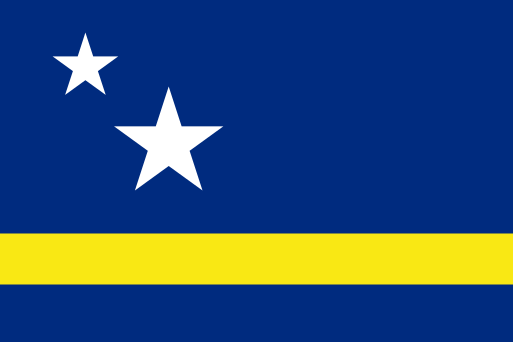
North America · Latin America and the Caribbean · Americas
CW · CUW
- Capital
- Willemstad
- Population
- 156,115
- Area
- 444 km²
- Democracy index
- 85
- Regime type
- Robust Democracy
Land Curacao (Dutch)/ Pais Korsou (Papiamento)
North America · Latin America and the Caribbean · Americas
CW · CUW
Events
The latest elections, referendums, and opinion polls from Curaçao. Community totals are not official results.
No public ballots yet
Check back later or explore the global feed.
Classification
The score and regime label are assigned by Porto Voto using our in-house democracy index and classification framework, not ratings from governments or external agencies.
Democracy index
85/100
Regime type
Robust Democracy
Curaçao operates as a stable parliamentary democracy within the Kingdom of the Netherlands, benefiting from a high degree of institutional autonomy and the protective framework of the Kingdom Charter. As of May 2026, the political environment is characterized by vigorous multi-party competition and a clear separation of powers between the executive and the Parliament (Estates). Recent governance efforts have prioritized fiscal transparency and anti-corruption measures, aimed at professionalizing the civil service and reducing political patronage in state-owned enterprises. The judiciary remains fiercely independent, often serving as a reliable arbiter in constitutional disputes and providing a robust check on government authority. Freedom of the press is firmly established, with a diverse range of media outlets that openly scrutinize the administration without fear of reprisal. While some challenges remain regarding the pace of public sector reform and the long-term impact of migration on social services, the fundamental democratic architecture—including civil liberties and the right to peaceful protest—is secure. International observers and the Kingdom's oversight bodies continue to view the electoral process as transparent and the transfer of power as orderly and accepted by the citizenry.
Last evaluation:
How we classify regimes →World Factbook
A concise introduction to Curaçao, together with notes on how power and law are organized, to put local ballots in context.
The original Arawak Indian settlers who arrived on Curaçao from South America in about A.D. 1000 were largely enslaved by the Spanish early in the 16th century and forcibly relocated to other colonies where labor was needed. The Dutch seized Curaçao from the Spanish in 1634. Once the center of the Caribbean slave trade, Curaçao was hard hit economically when the Dutch abolished slavery in 1863.
Its prosperity (and that of neighboring Aruba) was restored in the early 20th century with the construction of the Isla Refineria to service the newly discovered Venezuelan oilfields. In 1954, Curaçao and several other Dutch Caribbean colonies were reorganized as the Netherlands Antilles, part of the Kingdom of the Netherlands. In referenda in 2005 and 2009, the citizens of Curaçao voted to become a self-governing country within the Kingdom of the Netherlands.
The change in status became effective in 2010 with the dissolution of the Netherlands Antilles.