

Country profile
Croatia
Republika Hrvatska
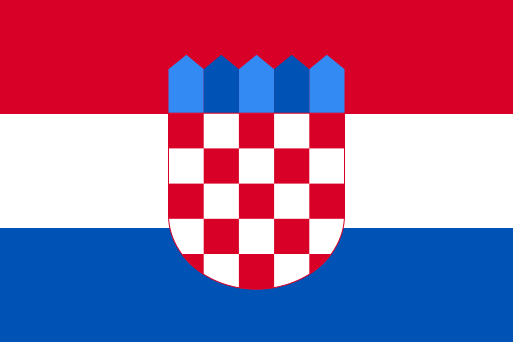
Europe · Southern Europe
HR · HRV
- Capital
- Zagreb
- Population
- 3,866,233
- Area
- 56,594 km²
- Democracy index
- 71
- Regime type
- Fragmented Democracy
Republika Hrvatska
Europe · Southern Europe
HR · HRV
Events
The latest elections, referendums, and opinion polls from Croatia. Community totals are not official results.
No public ballots yet
Check back later or explore the global feed.
Classification
The score and regime label are assigned by Porto Voto using our in-house democracy index and classification framework, not ratings from governments or external agencies.
Democracy index
71/100
Regime type
Fragmented Democracy
Croatia continues to operate as a stable parliamentary republic within the European Union, yet its democratic standing is increasingly defined by intense institutional friction and systemic polarization. Following the 2024 parliamentary elections and the subsequent formation of a coalition government involving the center-right HDZ and the right-wing Homeland Movement, the country has witnessed a notable shift toward more assertive executive rhetoric against independent oversight bodies. Tensions between the presidency and the prime minister's office remain a defining feature of the political landscape, often resulting in administrative deadlock regarding key judicial and military appointments. Concerns persist regarding the independence of the judiciary and the influence of political patronage, particularly following the controversial appointment of Ivan Turudić as State Attorney General, which critics argue undermines the fight against high-level corruption. Media pluralism is legally protected, but journalists frequently face SLAPP lawsuits and verbal hostility from senior officials, creating a chilling effect on investigative reporting. While civil liberties are generally respected and the electoral process is competitive, the concentration of power within a long-serving ruling party and the erosion of checks and balances keep the nation within the fragmented category rather than the robust tier. Ongoing protests in early 2026 regarding labor rights and transparency indicate a vibrant but frustrated civil society dealing with a governance model that often prioritizes political loyalty over institutional autonomy.
Last evaluation:
How we classify regimes →World Factbook
A concise introduction to Croatia, together with notes on how power and law are organized, to put local ballots in context.
The lands that today comprise Croatia were part of the Austro-Hungarian Empire until the end of World War I. In 1918, the Croats, Serbs, and Slovenes formed a kingdom known after 1929 as Yugoslavia. Following World War II, Yugoslavia became a federal independent communist state consisting of six socialist republics, including Croatia, under the strong hand of Josip Broz, aka TITO.
Although Croatia declared its independence from Yugoslavia in 1991, it took four years of sporadic, but often bitter, fighting before Yugoslav forces were cleared from Croatian lands, along with a majority of Croatia's ethnic Serb population. Under UN supervision, the last Serb-held enclave in eastern Slavonia was returned to Croatia in 1998. The country joined NATO in 2009 and the EU in 2013.
In January 2023, Croatia further integrated into the EU by joining the Eurozone and the Schengen Area.